*Reading Notes (Part Two) ~ Mao: the Unknown Story

By Jung Chang and Jon Halliday

Reading Notes (Part One) here. The tome is 613 pages long plus another almost 200 pages of chapter notes, bibliography and index. So I divided the notes in two parts. The first part chronicled Mao’s formative years and the two decades it took him to conquer the nation and become ‘the Chairman.’ This second part catalogues the geopolitical machinations of his colossal ego and a litany of resulting harms endured by the Chinese people.

The transition from Nationalist to Communist rule was managed without great disruption. This machine immediately assumed control of the country. Many old administrators stayed on, under their new Party bosses, and for a time the economy ran much as before. Private businessmen were told that their property would not be touched for a long while and that they must keep their factories functioning and shops open. Industry and commerce were not nationalised for some years, and the collectivisation of agriculture was not carried out until the mid-1950s. (323)

Some sectors, however, were subjected to instant drastic change. One was the law, were courts were replaced by Party committees. Another was the media, on which tight censorship was imposed at once; public opinion was stamped out. Mao would digest the rest of society gradually. Hundreds of Soviet advisors were assigned to China…a Stalinist state was being constructed even before Mao had formally assumed power. The new regime ran into armed resistance in the countryside and dealt with it without mercy. Once the state was secure, Mao began systematic terrorisation of the population, to induce long-term conformity and obedience. His methods were uniquely Maoist. (323)

In October 1950, Mao launched a nationwide “campaign to suppress counter-revolutionaries,” and devoted much energy to this, his first major onslaught since taking power, ordering his police chief to “send reports directly to me.” Mao issued order after order berating provincial cadres for being too soft and urged more “massive arrests, massive killings.” On 23 January 1951, for instance, he criticised one province for “being too lenient, and not killing [enough]”; when it raised its execution rate, he said this “improvement” made him feel “very delighted.” This nationwide campaign, which lasted a year, went hand in hand with the land reform in the newly occupied areas, where some two-thirds of China’s population lived. Some 3 million perished either by execution, mob violence or suicide. (324)

Mao intended most of the population—children and adults alike—to witness violence and killing. His aim was to scare and brutalise the entire population, in a way that went much further than either Stalin or Hitler, who largely kept their foulest crimes out of sight. More might well have been killed if it had not been for their value as slave labour. Mao said as much in one order: some people “had committed crimes that deserve to be punished by death,” but they must not be killed, partly because “we would lose a large labour force.” So millions were spared to be shipped to labour camps. With advice from Russian gulag experts on deportation and camp management, Mao sowed a vast archipelago of camps, the official term for which was laogai: “reform through labour.” A third and typically Maoist form of punishment was imposed on tens of millions of people during Mao’s reign. It was called being placed “under surveillance” while the victim remained in society. What it meant was “doing time on the outside,” kept on a kind of permanent knife-edge parole, one of the usual suspects to be rounded up and tormented afresh with any new bout of suppression. It meant one’s whole family living like outcasts. (325)

The high-visibility stigma served as a warning to the general public to never cross the regime. The terror worked. A report to Mao on 9 February 1951, only a few months into the campaign, said that after this first bout of killings, “rumour-mongering died down and social order stabilised.” What the state called “rumours” were often the only way people had to express their real sentiments. In one case, a seemingly bizarre alert spread not just from village to village, but from province to province: “Chairman Mao sends people to the villages to cut off [men’s] balls to give to the Soviet Union to make atom bombs.” (In Chinese, “balls” and “bombs” share the same pronunciation: dan.) In some places, when what looked like a tax collector appeared, the shout went up: “The ball-cutters are here!,” and the whole village would run for cover. This campaign clamped the lid down hard on any such expression of dissent, but there were still a few cracks in the system in those early years. (326)

But control became increasingly pervasive, and with it the loss of freedom on every front: of speech, movement, work, information. A nationwide system of concierges called Order-Keeping Committees was established in every factory, village and street, composed of members of the public, often the nosiest and most hyper-active busybodies, now made complicit with the regime’s repression. These committees kept an eye on everyone, not just political suspects and petty criminals. Above all, the regime nailed every person in China to a fixed, and usually immutable, job and place of residence through a registration system (hukou) begun in July 1951, which soon became iron-clad. (326)

The “campaign to suppress counter-revolutionaries” lasted a year, until October 1951, though routine suppression continued unabated after that. Mao then focused his attention on securing watertight control of the state coffers, to make sure that the funds the state extracted from the people did not revert to private hands. As corruption had been epidemic under the Nationalists [since forever, really], the campaign had genuine appeal. Many thought that the Communists were trying to root out corruption. What people did not realise was that whilst it was true that after this campaign few who had access to state money dared dip their hand in the till, the funds amassed in the state coffers were not going to be used for the interests of the people. Communist officialdom did become relatively uncorrupt in the conventional sense, such as not taking bribes, but it was granted a privileged standard of living, which was minutely graded hierarchically.  (328)

Mao himself did not embezzle in the conventional way, like lesser dictators who kept Swiss bank accounts. But this was simply because he did not need to hedge against losing power. He just made absolutely sure such a day would never come. Rather than embezzling, he treated the funds of the state as his own, and used them however he wanted, disregarding the needs of the population and persecuting any who advocated different spending priorities from the ones he laid down. When it came to personal lifestyle, Mao’s was one of royal self-indulgence, practised at tremendous cost to the country. This corrupt behaviour emerged as soon as he conquered China. (329)

Mao lived behind an impenetrable wall of secrecy, so that very few knew anything about his life and his world, including where he lived or where he was (he made few public appearances). Mao liked villas. During his twenty-seven-year rule, well over fifty estates were created for him, no fewer than five in Peking. Many he never set foot in. These estates were set in enormous grounds, mostly in gorgeous locations. There were often old villas on these spots, many of architectural splendour. These were torn down to make room for building designed and constructed under the supervision of his security forces…These purpose-built edifices were bullet- and bomb-proof; some had deep nuclear shelters. Sometimes, even Mao’s train drove into his villa—or strictly speaking, into the front garden, along a spur laid specially for him. In many places, an exclusive underground tunnel ran all the way from the villa to the local military airport. Mao frequently slept in his train parked at military airports, ready to make a quick getaway by train or plane, in case of emergency. Throughout his reign, he lived in his own country as if in a war zone. (331)

In no area of life did these double standards cause more misery than in the sphere of sexuality. Mao required his people to endure ultra-puritanical constraints. Efforts to relieve sexual frustration privately could lead to public humiliation. One patriotic Chinese who had returned to “the Motherland” was made to put a sign up over his dormitory bed criticising himself for masturbating. All the while, Mao was indulging in every sexual caprice in well-guarded secrecy…singers and dancers, nurses and maids, were handpicked for Mao’s villas to provide a pool of women from which he could choose whoever he wanted to have sex with. (333)

Mao’s paramount requirement from Stalin was help to build a world-class war machine, and turn China into a global power. The key to this was not how many weapons Stalin would provide, but the technology and infrastructure to manufacture armaments in China. (346) Control was one key reason Mao decided to shun Western recognition. But his primary reason was to show Stalin that the new China was committed 100 per cent to the Communist bloc. This was the main reason Peking did not establish diplomatic relations with America and most Western countries when the regime was founded. (347)

At Stalin’s insistence, China had not only paid huge salaries to Soviet technicians in China, plus extensive benefits for them and their families, but had to pay compensation to Russian enterprises for the loss of services of the technicians who came to China. But the concession Mao was most anxious to hide was that he had exempted Russians from Chinese jurisdiction. This had been the issue the CCP had always harped on as the embodiment of “imperialist humiliation.” Now Mao himself had secretly introduced it. (355)

[Mao and Stalin started the Korean War in 1949-50] Stalin recognized that Mao had the drive and the resources, especially the human resources, to expand the frontiers of communism in Asia significantly…By giving Mao custody of Vietnam, Stalin gave himself a way of reaching into Vietnam, and gratified Mao, while passing on to China the enormous expense of sustaining the Indochina insurgencies….Mao now began to take personal charge of action in Vietnam, vetting both grand strategy and the minutiae of military operations…. It was having China as a secure rear and supply depot that made it possible for the Vietnamese to fight for twenty-five years and beat first the French and then the Americans. (357)

In September to October 1950, Mao downgraded operations in Vietnam, in order to focus on a much larger war on another patch of turf that Stalin had decided to assign to him. This was Korea…Mao encouraged Pyongyang to invade the South and take on the U.S.A.—and volunteered Chinese manpower—as early as May 1949. At this stage he was talking about sending in Chinese troops clandestinely, posing as Koreans, and not about China having an open collision with America. (358) But for Stalin, the greatest attraction of a war in Korea was that the Chinese, with their massive numbers, which Mao was eager to use, might be able to eliminate, and in any case tie down, so many American troops that the balance of power might tilt in Stalin’s favour and enable him to turn his schemes into reality. These schemes included seizing various European countries, among them Germany, Spain and Italy. (358)

[President] Truman reacted fast to the invasion. Within two days, on the 27th, he announced he was sending troops into Korea, as well as upping aid to the French in Indochina. Furthermore, he now reversed the policy of “non-intervention” towards Taiwan. It was thanks to this new U.S. commitment that neither Mao nor his successors were ever able to take Taiwan. (361)

Among those who died in Korea was Mao’s eldest son An-ying, killed in an American air raid on Peng Dehuai’s HQ, where he was working as Peng’s Russian translator. It was 25 November 1950, just over a month after he had entered Korea. He was twenty-eight. He had married only a year before, his wife Siqi was a kind of adopted daughter to Mao, and she and An-ying had known each other for some years. When Mao was given the news of his son’s death, he was silent for some time, and then murmured: “In a war, how can there be no deaths?” Nobody informed An-ying’s widow for over two and a half years. While the war was still going on, she accepted An-ying’s silence, as she was used to Party secrecy. But in summer 1953, after the signing of the armistice, she found his continued silence puzzling, and asked Mao, who told her that An-ying was dead. During those years she had been seeing Mao constantly, spending weekends and vacations with him [she was very beautiful and one of Mao’s favourites], and he had not shown any sadness, not even a flicker to suggest anything was wrong. He had even cracked jokes about An-ying as though he were alive. (379)

After Mao had accepted an end to the Korean War, in May 1953, Stalin’s successors in the Kremlin agreed to sell China ninety-one large industrial enterprises. With these assured, on top of the fifty projects agreed to by Stalin, Mao was able to launch his blueprint for industrialization on 15 June. This focused exclusively on building up arms industries, to make China a superpower. It was in effect Mao’s Superpower Programme. Its utterly military nature was concealed, and is little known in China today. [as in 2005 when this book was published] (380)

Mao wanted to channel every resource the nation had into this programme. For decades to come, Mao’s determination to preside over a military superpower in his own lifetime was the single most important factor affecting the fate of the Chinese population. According to official statistics, spending during this period [1953-57] on the military, plus arms-related industries, took up 61 per cent of the budget—although in reality the percentage was much higher, and would rise as the years progressed. In contrast, spending on education, culture and health combined was a miserable 8.2 per cent, and there was no private sector to fall back on when the state failed to provide. In order to save money on health, the regime resorted to schemes like hygiene drives, which called for killing not only flies and rats, but in some areas also cats and dogs, although, curiously, it never extended to cleaning up China’s stinking, and pestiferous, toilets, which survived uncleansed throughout Mao’s reign. (381)

The Chinese were told, vaguely but deliberately, that equipment from the USSR used in China’s industrialisation was “Soviet aid,” implying that the “aid” was a gift. But it was not. Everything had to be paid for—and that meant mainly with food, a fact that was strictly concealed from the Chinese people, and still largely is. China in those days had little else to sell. Trade with Russian, Choe En-lai told a small circle, “boils down to us selling agricultural products to buy machines.” (381)

What China was exporting to Russia, and its satellites, consisted overwhelmingly of items that were basic essentials for its own people, and included all the main products on which China’s own population depended for protein: soybeans, vegetable oil, eggs and pork, which were always in short supply. With only 7 percent of the world’s arable land, and 22 per cent of its population, land was too precious to raise livestock in most places, so most Chinese had no dairy products and very little meat. (382)

The main impact fell on the peasants. Policy was to guarantee basic food to the urban population, with strict rationing, and leave the peasants to starve when the inevitable food shortages struck. Those registered as peasants at the time Mao took power were forbidden to move into urban areas or to change their status. Peasants were not even allowed to move to another village except with special permission (e.g., if they married). Otherwise they were nailed to their village for life. And so were their children and grandchildren. This total immobility was something new in China. Traditionally, peasants had always been able to move geographically as well as socially. They had been able to aspire to fame and fortune—as Mao had done. If there was famine, they had been able to flee into towns or other regions and at least try their luck. Now, even at the best of times, they could never hope to improve their lot, except when the government enrolled them into the army, or into a factory. [As for urban areas] the threat of rustification functioned as a powerful deterrent to urban dwellers not to step out of line. Everyone knew that being cast into the peasantry would bring on themselves and their families not only back-breaking labour, but the loss of certainty of earning a livelihood, and that this misfortune would extent to future generations as well. (383)

On one excursion to the top of a hill, Mao saw a thatched hut on fire in the distance. The inhabitants were standing outside, helpless as the flames swallowed their home. According to Mao’s photographer, Mao “turned to me with a glance, and said coolly: ‘Good fire. It’s good to burn down, good to burn down!’” Throughout his reign, peasants had to fend for themselves when it came to housing. The state provided no funds. Even in urban areas, other than apartments for the elite and residential blocks in industrial complexes, virtually no new dwellings were built. (390)

From the time he conquered China, Mao was determined to take Tibet by force. When he saw Stalin on 22 January 1950, he asked if the Soviet air force could transport supplies to Chinese troops “currently preparing for an attack on Tibet.” Stalin’s reply was “It’s good that you are preparing to attack. The Tibetans need to be subdued…” Staling also advised flooding Tibet and other border regions with Han Chinese: “Since ethnic Chinese make up no more than 5 per cent of Xinjiang’s population, the percentage of ethnic Chinese should be brought to 30…In fact, all border territories should be populated by Chinese…” This is exactly what the Chinese Communist regime then proceeded to do. So Mao played the negotiation game, pretending that he would allow the area virtual autonomy. Acting the benign moderate, he recognized the Dalai Lama, Tibet’s spiritual and governmental leader, as the head of Tibet, sent him gifts like a 16mm film projector, and said reassuring things to Tibetan delegations. Meanwhile he pressed ahead with building two roads into Tibet. (453)

Mao knew about his interest in science. “I know you are a reform-minded man, like myself,” Mao said. “We have lots of things in common,” citing educational reform. “That was the danger with Mao,” the Dalai Lama told us, “everything he said—half true! Half true!” But along with the lulling, Mao was also patronising and bullying, berating the Dalai Lama for not accepting that “religion is poison.” Early in 1956, once the two major roads had been completed into Tibet, Mao set about requisitioning food, attacking religions and confiscating arms in a region called Kham, adjacent to Tibet and inhabited by some half million Tibetans. The people rebelled, and by the end of March had mustered an armed force of over 60,000 men with more than 50,000 guns. Rebellions spread like wildfire in other regions where Tibetans formed a majority. Mao found himself with major wars on his hands covering huge areas of the interior; he resorted to using heavy artillery and aerial bombardment. (454)

Many Tibetans had managed to hang onto their firearms, which for herdsmen were essential for their livelihood. They also had horses, which gave them mobility. But above all they had their own separate identity, language and religion, which enabled them to organize in secret. Mao made it explicit he positively wanted a violent, crushing solution. “In Tibet,” he wrote on 22 January the following year, “there has to be a general decisive war before we can solve the problem thoroughly. The Tibetan rulers…now have a 10,000 strong rebelling armed force with high morale, and they are our serious enemies. But this is…a good thing. Because this makes it possible to solve our problems through war.” Mao was saying: They have given me an excuse to start a war. A month later, he wrote: “The bigger the upheaval the better.” (454)

On 10 March 1959, an uprising broke out in Lhasa, after word spread that the Chinese planned to kidnap the Dalai Lama. Thousands paraded in front of his palace and through Lhasa, shouting “Chinese get out!” Next day, Mao cabled an order to let the Dalai Lama escape. His calculation was that if the Dalai Lama was killed it would inflame world opinion, particularly in the Buddhist countries and India, which Mao was courting. On the night of the 17th the Dalai Lama made his way out of Lhasa and set off for India. Once his escape was confirmed, Mao told his men: “Do all you can to hold the enemies in Lhasa…so when our main force arrives we can surround them and wipe them out.” (455)

On the 29th, following Mao’s orders, a vigorous media campaign began painting Tibet as a terrifying place, where gruesome tortures of the kinds Mao had mentioned, plus gouging out eyes, were everyday occurrences. Aided by age-old prejudices, this propaganda drive was effective, and Mao succeeded in planting the idea in people’s minds that Tibet was a land of barbarism. There had been a very dark side to the rule of the old Tibetan theocracy, but in terms of overall brutality and suffering, Mao’s rule was far worse. Requisitioning was brutal: “nearly all reserve food, meat and butter were confiscated…There was no oil to light lamps, not even firewood…To survive, herdsmen had to eat many of their animals…” The population was herded into canteens, where they were fed “weeds, even inedible tree bark, leaves, grass roots and seeds.” Food traditionally fed to animals had “now become rare nutritious delicious foods.” People’s health declined dramatically: “A tiny infectious illness like a cold led to…masses of deaths. Quite a lot…also died directly of starvation…Death rate was really terrible…Such awful pain of hunger had never existed in Tibetan history.” (456)

Large numbers of Tibetans were put through violent denunciation meetings, including the father and family of the Panchen Lama, who wrote: “People were beaten till they bled from the eyes, ears, mouths, noses, they passed out, their arms or legs broken…others died on the spot.” For the first time in Tibet, suicide became a common practice. With so many Tibetans joining rebellions against Mao’s regime, Chinese troops treated most Tibetans as enemies, rounding up the majority of adult males in many places, leaving only “women, the old, the children and extremely few young and middle-aged men.” After Mao’s death, the Panchen Lama revealed what he had not dared put in his original letter that a staggering 15-20 percent of all Tibetans—perhaps half of all adult males—were thrown into prison, where they were basically worked to death. (456)

The crushing of the rebellions produced atrocious behaviour on the part of Chinese troops. In one place, the Panchen Lama described how “corpses were dragged down from the mountains” and buried in a big pit, and the relatives were then summoned and told: “We have wiped out the rebel bandits, and today is a day of festivity. You will all dance on the pit of the corpses.” Atrocities went in parallel with cultural annihilation. This period witnessed a campaign officially called “Big Destruction,” in which the entire Tibetan way of life came under violent physical assault for being “backward, dirty and useless.” Mao was bent on destroying religion, the essence of most Tibetans’ lives. (456)

“Holy Scriptures were used for manure, and pictures of the Buddha and sutras were deliberately used to make shoes,” the Panchen Lama wrote. The destruction was of a kind that “even lunatics would hardly carry out.” Most monasteries were destroyed, “the sites looking as if they had just been through a war and bombardments.” According to the Panchen Lama, the number of monasteries in Tibet fell from over 2,500 before 1959 to “only just over 70” in 1961, and the number of monks and nuns from over 110,000 to 7,000 (some 10,000 fled abroad). On his tours in the early 1960s, Tibetans came at great risk to see the Panchen Lama, crying out and weeping: “Don’t let us starve! Don’t let Buddhism be exterminated! Don’t let the people of the Land of Snows become extinct!” Mao was “greatly displeased” with the Panchen Lama’s letter, and visited much suffering upon him, including ten years in prison.  (457)

In February 1959, Russia signed an agreement to provide China with the means to make nuclear submarines. This marked the high point of the Kremlin’s cooperation on technology transfers. But even while the deal was being signed, Khrushchev was having second thoughts about endowing Mao with such enormous military power. Mao, he felt, “was bursting with an impatient desire to rule the world.” Khrushchev gave orders to go slow on transferring nuclear know-how and on 20 June 1959 he suspended assistance on the Bomb. To have his own camp, and not have to play second fiddle to Khrushchev, had long been Mao’s dream. As Khushchev had begun to dry up as a source of military hardware, Mao felt less concerned about annoying him. Nor did he want a split from him either, as Russia was still handing over a wealth of military technology, with no fewer than 1,010 blueprints transferred in 1960 alone—more even than in 1958. (458)

So Mao formulated a policy of “not to denounce” the Russians “for the time being” and sought to milk them of everything he could as fast as he could. “China will become powerful in eight years,” he told his top echelon, and Khrushchev “will be completely bankrupt.” The goal for now, he told his inner circle at the beginning of 1960, was “to propagate Mao Tse-tung Thought” round the world. At first, the drive should not be too aggressive, in order, as he put it, not to be seen to be trying to “export our fragrant intestines” (to which Mao compared his “Thought”). The resulting propaganda campaign brought the world “Maoism.” The idea of promoting China’s experience as a model when the Chinese were dying of starvation in their millions might seem a tall order, but Mao was not perturbed: he had watertight filters on what foreigners could see and hear.  (459)

Mao made sure that no Chinese except a very carefully vetted elite could get out of the country. The only people who got out and would talk were a small number of daring ordinary citizens who risked their lives and swam to Hong Kong. They broke the wall of silence around Mao’s famine and the dark realities of Red China in general. But their voices won little credence in the West. The future Canadian prime minister Pierre Trudeau came in 1960 and co-wrote a starry-eyed book, Two Innocents in Red China, which rejected reports of famine. Even the former chief of the UN’s Food and Agricultural Organization, Lord Boyd-Orr, was duped. (460)

Mao’s self-promotion abroad was fuelled by vastly increased handouts of his usual trio: arms, money and food. This spree of gifts by Mao coincided with the worst years of the greatest famine in world history. Over 22 million people died of starvation in 1960 alone. (461)

In Latin America, Peking made a beeline for Cuba after Fidel Castro took power in January 1959. When Casto’s colleague Che Guevara came to China in November 1960, Mao doled out U.S. $60 million as a “loan,” which Chou En-Lai told Guevara “does not have to be repaid.” In the Communist bloc itself, Mao worked on trying to acquire influence in every country, but only managed to detach one client from Russia’s sphere of influence: tiny poverty-stricken Albania. Thanks to food donated by China, the Albanians did not even know what rationing was, while the Chinese were dying in their tens of millions. Spotting Peking’s crude criteria for allegiance, freeloaders jumped aboard the gravy train. …Venezuelan leftists walked off with U.S. $300,000 of China’s money funnelled through Albania. Dutch intelligence set up a bogus Mao Party, which was funded and fêted by the Chinese. The CIA’s top China hand, James Lilley, told us they were delighted to discover how easy it was to infiltrate China: simply get a few people to chant hosannas to Mao and set up a Maoist party, which Peking would then rush to fund—and invite to China. (These spies, however, were useless, as all foreigners were rigidly segregated from the Chinese.) (462)

Mao had miscalculated. Russian retaliation came at a highly disadvantageous time. Although his scientists had secured the technology to make a Bomb, the Russians had not finished imparting their expertise in building the delivery system: the missiles. The Chinese scrambled, telling their scientists to seize every minute and dig things out of the Russians before they left, by hook or by crook. Song-and-dance girls were brought in to get Soviet minders drunk and detain them on the dance floor, while Russian scientist’s notebooks were photographed. Even so, the missile program, and indeed the entire Superpower Programme, was thrown into disarray. Mao’s impatience to promote himself as a world leader, and rival to Khrushchev, had led him to shoot himself in the foot. (464)

Scores of large-scale projects were cancelled. Mao later blamed the famine that he himself had created on their cancellation, which he alleged had damaged China’s economy, and his claim is believed in China to this day. In fact, the cancellations should have eased the famine: China could now export less food. (465)

At the end of May 1966, Mao set up a new office, the Cultural Revolution Small Group, to help run the Purge. Mme Mao headed it for him…Under the new cabal, the cult of Mao was escalated to fever pitch. In June, Mao intensified the terrorisation of society. He picked as his first instrument of terror young people in schools and universities. These students were told to condemn their teachers and those in charge of education for poisoning their heads with “bourgeois ideas”—and for persecuting them with exams, which henceforth were abolished. The young were told that their role was to “safeguard” Mao, although how their teachers could possibly harm “the great Helmsman,” or what perils might beset him, was not disclosed. Nevertheless, many responded enthusiastically. Taking part in politics was something no one had been allowed to do under Mao, and the country was seething with frustrated activists who had been denied the normal outlets available in most societies, even to sit around and argue issues. Now, suddenly, there seemed to be a chance to get involved. To those interested in politics, the prospect was tremendously exciting. (514)

On 2 June, a group from the middle-school in Peking put up a wall poster, which they signed with the snappy name of “Red Guards,” to show they wanted to safeguard Mao. Their writing was full of remarks like “Stuff human feelings!” “We will be brutal!” “We will strike you [Mao’s enemies] to the ground and trample you!” The seeds of hate that Mao had sown were ready for reaping. Now he was able to unleash the thuggery of these infected teenagers, the most malleable and violent element of society. To make sure that students were fully available to carry out his wishes, Mao ordered schooling suspended from June 13. “Now lessons are stopped,” he said, and young people “are given food. With food they have energy and they want to riot. What are they expected to do if not to riot?” Violence broke out within days. On 18 June scores of teachers and cadres at Peking University were dragged in front of crowds and manhandled, their faces blackened and dunces’ hats put on their heads. They were forced to kneel, some were beaten up, and women were sexually molested. Similar episodes happened all over China, producing a cascade of suicides. (515)

Over the next four months, 11 million young people came to Peking and Mao made seven more appearances at Tiananmen Square, where they gathered in massive, frenzied, yet well-drilled crowds. There was not one school in the whole of China where atrocities did not occur. After terror in schools, Mao directed his Red Guards to fan out into society at large…and called on Red Guards throughout the country to “smash old culture.” …Mao wanted something much more vicious [than beatings, torture and murder]. On 23 August he told the new authorities: Peking is not chaotic enough…Peking is too civilized.” As Peking was the trail-blazer and the provinces all copied the capital, this was a way to pump up terror nationwide. That afternoon, groups of teenage Red Guards, many of them girls, descended on the courtyard of the Peking Writers’ Association…the Red Guards rained blows with their heavy belts on some two dozen of the country’s best-known writers.

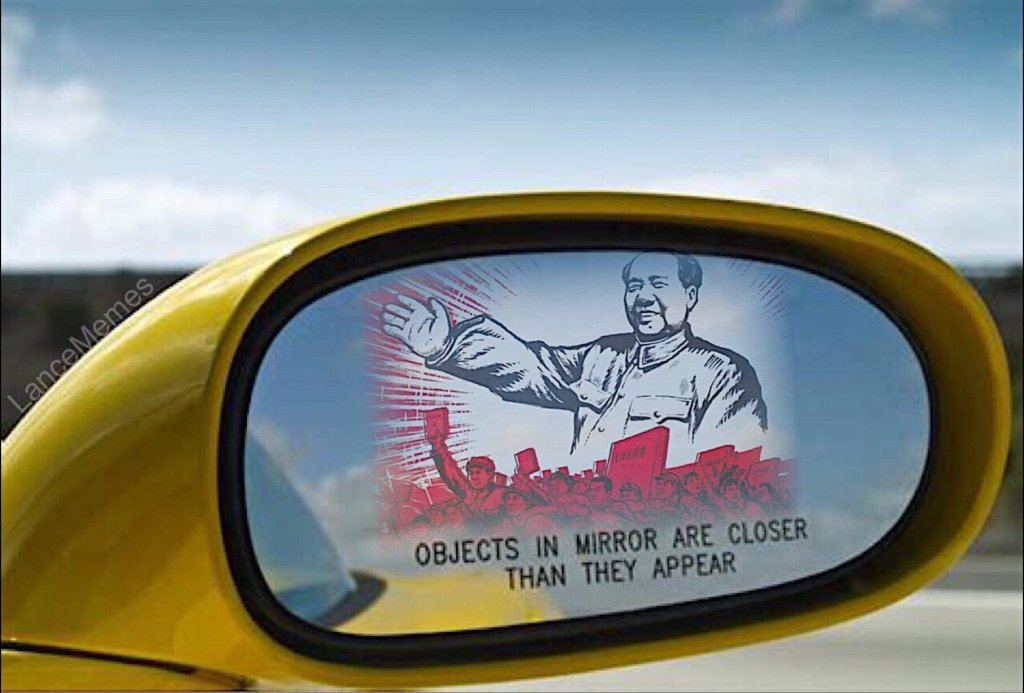
MEME

Large insulting wooden plaques were hung on thin wire from the writers’ necks, as they were thrashed in the scorching sun. Mao also cleared the way for the atrocities to escalate by issuing orders to the army and police…saying they must “absolutely not intervene” against the youngsters, using uncommonly specific language such as “even firing blanks…is absolutely forbidden.” (518)

To spread terror deeper and closer to home, Mao got the young thugs to make violent raids on victims selected by the state, which gave their names and addresses to the Red Guards. It was with the authorities’ blessing that the Red Guards broke into homes where they burned books, cut up paintings, trampled phonograph records and musical instruments—generally wrecking anything to do with “culture”. They “confiscated” valuables and beat up the owners. One of Mao’s aims with the house raids was to use the Red Guards as proxy bandits. They confiscated tons of gold, silver, platinum, jewellery, and millions of dollars in hard currency, which all went into the state coffers, as well as many priceless antiques, paintings and ancient books. (520)

In the summer of 1966, Red Guards ravaged every city and town, and some areas of the countryside. “Home,” with books and anything associated with culture, became a dangerous place. Fearing that the Red Guards might burst in and torture them if “culture” was found in their possession, frightened citizens burned their own books or sold them as scrap paper, and destroyed their own art objects. Mao thus succeeded in wiping out culture from Chinese homes. Outside, he was fulfilling his long-held goal of erasing China’s past from the minds of his subjects. A large number of historical monuments, the most visible manifestations of the country’s civilisation, which had so far survived Mao’s loathing, was demolished. In Peking, of 6,843  monuments still standing in 1958. 4,922 were now obliterated. (521)

Epilogue: Today, Mao’s portrait and his corpse still dominate Tiananmen Square in the heart of the Chinese capital. The current Communist regime declares itself to be Mao’s heir and fiercely perpetuates the myth of Mao. (631)

* Reading Notes ~ Imperial Twilight – the Opium War and the End of China’s Last Golden Age

by Stephen R. Platt

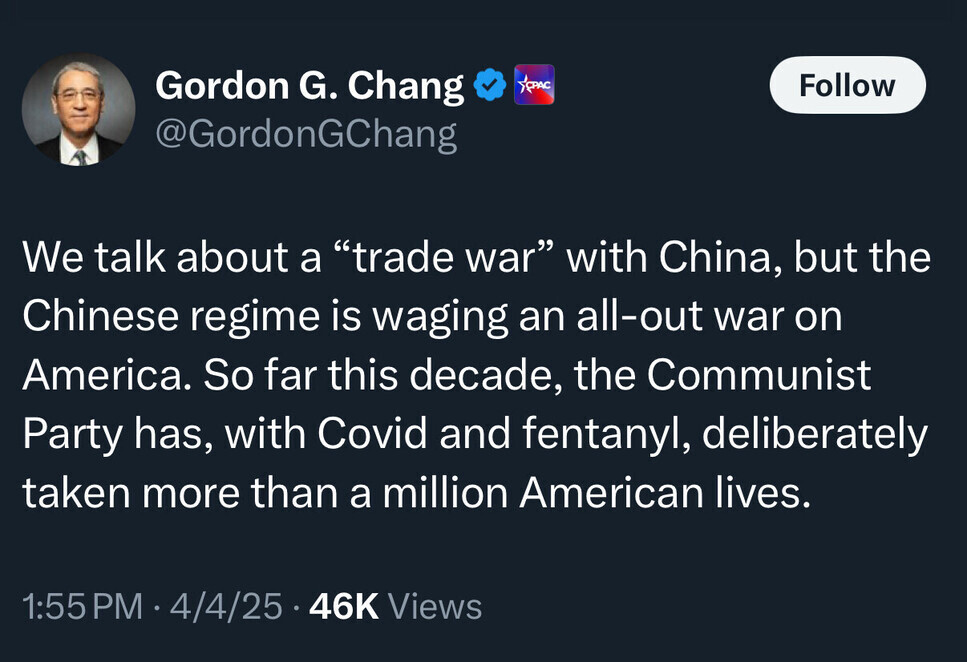
I keep hearing Sino pundits say that China is motivated to conquer the West with fentanyl and other devious methods of warfare in retaliation for the ‘humiliation’ they suffered due to opium and the Opium Wars. And I don’t buy that explanation one bit. They have always been into devious warfare and the humiliation story is simply propaganda of convenience and deception.

In many ways, the so-called ‘loss of face’ that is supposed to be part of Chinese culture is simply male ego not wanting to admit culpability and disastrous short-comings. Endemic, chronic corruption and abuse by a vast network of bullying bureaucrats had impoverished the people for centuries. When modernity came to China’s shores, China was in the grip a 1000-year tradition of China’s ruling caste of “emperors” living in absolute splendour. Modernity revealed a long chain of cause and effect and perilous weakness.

As for the Opium Wars, within China opium had been used since the 1200s by the royal courts and their massive retinues—each royal had hundred/thousands of slaves and eunichs and everyone used opium. Opium use and production continued right into the 20th century. In the 1930s, 40s, 50s, opium funded endless warring as Stalinist Communism gradually, over those decades, overcame the nation. Chairman Mao was the ultimate winner because (1) in the 40s he got into the opium production game which stuffed his coffers full of much-needed money and (2) he was the most devious and brutal of them all. Read Mao: the Unknown Story by Jung Chang, it’s >600 pages and a real eye-opener.
But back to reading notes from Platt’s Imperial Twilight and me looking for details that would contradict/complicate/disassemble that opium humiliation narrative.

Opium use in China was primarily a luxury of the wealthy and their huge retinue of eunuchs who served them.

Same old same old playbook we see everywhere else. The ruling class, contrary to their incessant claims, did not look after the people properly. The poverty class could not buy land, many were driven off the land and lived on river boats and eventually organized into a pirate class.

The White Lotus rebels on land were poor and desperate to overturn Peking rule. The war against them bankrupted the emperor whose “taxes” came from wealthy traders in the south, whose wealth came from trading tea primarily to the British, but other nations also. The Canton tea trade and the British East India Company were dominant in trade exports. Then came opium.

Steady but small market for opium within China which was not profitable, compared to the Canton tea trade. Though opium was illegal, a rogue commerce was well established.

“Opium by the early 19th century had been long established as a high-end luxury good and despite various edicts condemning it, there seemed from the outside to be no social stigma to its purchase or use.” (p.195)

Competition within India to grow poppies resulted in a glut of opium, which eventually drove prices down, making it less expensive to buy in China so people who weren’t wealthy began indulging in it. When East India Company lost its opium monopoly to independent poppy growers in India, the rate of opium use in China exploded.

Jardine, Matheson and Company (2 Scotsmen) endures to this day as a major multi-national conglomerate headquartered in HK with more than 44K employees.

Matheson imported a printing press to Canton in order to publish the Canton Register. Its purpose was to share shipping news and advocate for the doctrine of free trade.

Super interesting but hardly known Indian character in the opium trade: Jamsetjee Jeejeebuoy—rags to riches story, Bombay philanthropist.

Opium was forbidden but traders also knew it was welcome and trading in it carried almost no risk of punishment. Chinese government efforts to suppress the relatively open traffic were infrequent and half-hearted (205) because many officials were themselves opium users or otherwise involved. Nothing Peking did to rein in corruption worked, decade after decade, emperor after emperor. Chinese enforcement was not just ineffective but almost non-existent.

Dynasties, imperial families, all rotten. All hedonists. Poppies cultivated in the Tang dynasty in the 8thcentury. Chinese medical texts described opium as a medicinal. From 1730s to 1810 not a single case of clear-cut prosecution for opium offences in the Qing empire. Eunuch servants in emperor courts outnumbered the royal family 40 to 1 and they all smoked opium. Opium smoking in the general population spread easily enough.

When opium use went from ingesting to smoking it, that’s when opium became huge. “Imperial guards and government officials were using it. It was becoming socially respectable (225). Even Chinese scholars were opium addicted.

In 1820, a few 100s of one percent of the population were using. 5000 chests of opium brought in per year would supply 40K habitual users nation-wide.

“Against latter day nationalist claims that the British came and forced opium down the throats of helpless Chinese consumers, there was in fact a domestic opium production in China already in place to compete with the import market in Canton (especially in the empire’s western and south western provinces)”. (227)

Traders couldn’t even get into the country, all they could do was to carry their opium to China’s southern coast and sell it to the Chinese agents. Everything from there on into the Qing empire was entirely in Chinese hands.” (228)

One scholar, Bao Shichen, in early 1800s said, “By the time I was a young student, everything was falling apart. Bribery was pervasive and open, the administration was contaminated and vile, and people’s energy was taut like a spring, as if there might be rebellion.” (233)

Over several centuries, “conditions in China were getting worse. Successive dynasties rarely left China in a more solid position than they found it. Patronage, bribery, and embezzlement were the accepted norm among civil officials, especially in the lower orders.” (302)

Taiwan belonged to the Dutch who conquered the aborigines who were not Chinese. A massive influx of Chinese to Taiwan occurred when no good land was available in China.

Matheson pushed hard for war with China. Typical capitalist playbook: once big profits are being made, giving it up will not happen without a fight.

Two decades of dithering, China seemed paralyzed by its internal inertia, the severity of corruption, the size of the nation, but gradually found its footing and got tough. In 1839 the sh*t hit the fan.

The political machinations ground on, power plays, warring, the usual male pattern sociopathy. After a brief “war,” in which the Brits lived up to their moniker of “barbarians,” the Brits got a payment for their opium product that was destroyed and the right to set up residence on a then-empty island called Hong Kong.

Matheson funneled “the vast fortune from his China trade (opium included) back into real estate in Scotland; Matheson would die the 2nd-largest landowner in the entire UK.” (452)

“[Little is said] of the fact that so much of that ‘substantial good’ [Jeejeebuoy’s philanthropy] dispensed to such a ‘large portion of the human race’, was made possible by Jeejeebuoy’s sale, through Jardine and Matheson, of Indian opium to Chinese smugglers.” (433)

Some British Lords and other privileged politicos condemned slavery while fighting a war in support of opium traffickers. The toxic male brotherhood a.k.a. ‘capitalism’ always exists.

After the war, opium imports INCREASED. 1850s. Then, with legalization, the domestic production produced 10X more than imported quantities. “China wallowed in a quagmire of official corruption it could not escape.” (446)

**Opium money—through the fortunes of the Forbes brothers [ancestors of today’s Forbes magazine] financed the building of US railroads in the American mid-west.

-30-

* Reading Notes (Part One) ~ Mao: the Unknown Story 

*Reading Notes (Part One) ~ Mao: the Unknown Story 

by Jung Change and Jon Halliday

This is a tome, or a brick, depending on your level of book-love. 613 pages then another nearly 200 pages of chapter notes, bibliography and index. If I wrote down all the notes I wanted to, I’d be writing a novel myself—even still, there are so many I’ve divided them into two parts. The authors leave no stone unturned, no turn unstoned. If you’re not into reading, the synopsis is this: in his youth Mao Tse-tung was a lazy, lying, selfish, aimless boy who loved his mother and hated his father. Gradually, as he matured, he learned that he enjoyed abusing people. He was thrilled by extreme violence and torture; “Mao discovered in himself a love for bloodthirsty thuggery”. His power-hunger and slash-and-burn looting accelerated his ambitions and led him directly into Communist politics. He was driven by devious ambition; he used, manipulated and betrayed everyone who trusted him in order to get more for himself, including the despot Stalin. He stopped at nothing to get more power. He was universally loathed, even by his soldiers; on the Long March he would execute soldiers and hang them in trees along the road where his army marched, to dissuade deserters. He was, in the clearest sense, a raging psychopath. He did nothing good for the peasantry and brought great harms instead. If you’re thinking Communism could be an antidote to late capitalist rot, this book will shake that notion right out of you. The essential problem with all political/economic systems are the psychopathic personalities who inevitably get to positions of extreme power. And if ever a soul should rot in hell, it’s Mao Tse-tung’s. 

“This is a bombshell of a book.” ~ Chris Patten, last governor of Hong Kong

From late 1920, when he entered the Communist orbit, Mao began to use expressions like “workers and peasants” and “proletariat”. But they remained mere phrases, part of an obligatory vocabulary. Decades later, Mao talked about how, as a young man in Shaoshan, he cared about people starving. The record shows no such concern. Mao’s peasant background did not imbue him with idealism about improving the lot of Chinese peasants. (9) 

Mao’s attitude to morality consisted of one core, the self, “I”, above everything else. “I do not agree with the view that to be moral, the motive of one’s action has to be benefiting others. Morality does not have to be defined in relation to others….People like me want to…satisfy our hearts to the full, and in doing so we automatically have the most valuable moral codes. Of course there are people and objects in the world, but they are all there only for me.” (13) 

The other central element in his character which Mao spelt out now was the joy he took in upheaval and destruction. “Giant wars,” he wrote, “will last as long as heaven and earth and will never become extinct….The ideal of a world of Great Inequality and Harmony [da tong, Confucian ideal society] is mistaken.” This was not just the prediction that a pessimist might make; it was Mao’s desideratum, which he asserted was what the population at large wished. “Long-lasting peace,” he claimed, “is unendurable to human beings, and tidal waves of disturbance have to be created in this state of peace…When we look at history, we adore the times of [war] when dramas happened one after another…which make reading about them great fun. When we get to the periods of peace and prosperity, we are bored…Human nature loves sudden swift changes.” Mao simply collapsed the distinction between reading about stirring events and actually living through cataclysm. He ignored the fact that, for the overwhelming majority, war meant misery. (14) 

When he came to the question “How do we change [China]?,” Mao laid the utmost emphasis on destruction: “the country must be…destroyed and then re-formed.” He extended this line not just to China but to the whole world—and even the universe: “This applies to the country, to the nation, and to mankind…The destruction of the universe is the same…People like me long for its destruction, because when the universe is destroyed, a new universe will be formed. Isn’t that better!” These views, worded so clearly at the age of twenty-four, remained at the core of Mao’s thinking throughout his life. (15) 

In an article written on 21 November 1919, shortly after his mother’s death, and entitled “On Women’s Independence,” Mao claimed that “Women can do as much physical labour as men. It’s just that they can’t do such work during childbirth.” So his answer to “women’s independence” was that “women should prepare enough…before they marry to support themselves,” and even that “women should stockpile necessities for the period of childbirth themselves.” Evidently, as a man, Mao did not want to have to look after women. [Or his wives, or his children, as his life revealed.] When he came to power, the core of his approach to women was to put them to heavy manual labour. (18)  

In June 1920, Mao called on a Professor Ch’en Tu-hsiu, at the time China’s foremost Marxist intellectual. It was crucial encounter that would change his life. The professor was in the midst of forming a Chinese Communist Party (CCP). Mao had written a long article calling him “a bright star in the world of thought.” Aged forty, Chen was the undisputed leader of Chinese Marxists, a true believer, charismatic, with a volatile temper. The idea of forming the Communist Party did not stem from the professor, nor from any other Chinese. It originated in Moscow. In 1919, the new Soviet government had set up the Communist International, the Cominterm, to foment revolution and influence policy in Moscow’s interest around the world. In August, Moscow launched a huge secret programme of action and subversion for China, starting with a commitment of money, men and arms three decades long, which culminated in bringing the Communists under Mao to power in 1949—Soviet Russia’s most lasting triumph in foreign policy. (19) 

Approaching twenty-seven, Mao had become a Communist—not after an idealistic journey, or driven by passionate belief, but by being at the right place at the right time, and being given a job that was highly congenial to him. He had effectively been incorporated into an expanding organization. Mao was no fervent believer. This absence of heartfelt commitment would result in a most unconventional and unusual relationship with his Party throughout his life, even when he was head of that Party. (20) 

Without Moscow’s funding the CCP could not even begin to carry out any activities such as publishing Communist literature and organizing a labour movement. Over a nine-month period (October 1921—June 1922), out of its expenditure of 17, 655 yuan, less than 6 per cent was raised inside China, while over 94 per cent came from the Russians, as Ch’en himself reported to Moscow. Indeed, there were many other Communist groups in China at the time—at least seven between 1920 and 1922, one claiming as many as 11,000 members. But without Russian funds, they all collapsed. Unlike Ch’en, Mao showed no qualms about taking Moscow’s money. He was a realist. Russian funding also transformed his life. After the congress he began to receive 60-70 yuan a month from the Party for his Hunan branch, soon increased to 100, and then 160-170. This large and regular income made a tremendous difference. Mao had always been short of money. He had two jobs, headmaster and small-time journalist, and he dreaded having to depend on these two occupations to make his living. (27) 

It was only now, when he was thirty-two, that Mao—assumed by many to this day to have been the champion of poor peasants—took any interest in their affairs. Under Mao, the Peasant Institute churned out agitators who went into the villages, roused the poor against the rich and organized them into “peasant associations”. Now, because the Nationalists [rivals to the Communists headed by Chiang Kai-shek] were following Russian instructions aimed at bringing about a Soviet-style revolution, social order broke down for the first time. Violence erupted as poor peasants helped themselves to the food and money of the relatively rich, and took revenge. Thugs and sadists also indulged themselves. By December there was mayhem in the Hunan countryside. In this capacity as a leader of the peasant movement, Mao was invited back to his home province to give guidance. (40)

Though Mao did not address the issue of violence, his general approach was not militant. Shortly afterwards he went off on an inspection tour of the Hunan countryside. By the end of the tour, which lasted thirty-two days, he had undergone a dramatic change. Mao himself was to say that before this trip he had been taking a moderate line, and “not until I stayed in Hunan for over thirty days did I completely change my attitude.” What really happened was that Mao discovered in himself a love for bloodthirsty thuggery. This gut enjoyment, which verged on sadism, meshed with, but preceded, his affinity for Leninist violence. Mao did not come to violence via theory. The propensity sprang from his character, and was to have a profound impact on his future methods of rule. (41) 

Mao was very taken with one weapon, the suobiao, a sharp, twin-edged knife with a long handle like a lance: “it…makes all landed tyrants and bad gentry tremble at the sight of it. The Hunan revolutionary authorities should…make sure every young and middle-aged male has one. There should be no limit put on [the use of] it.” Mao saw and heard much about brutality, and he liked it. In the report he wrote afterwards, in March 1927, he said he felt “a kind of ecstasy never experienced before.” His descriptions of the brutality oozed with excitement,  and flowed with an adrenaline rush. “It is wonderful! It is wonderful!” he exulted. Mao did not once address the issue that concerned peasants most, which was land redistribution. What fascinated Mao was violence that smashed the social order. And it was this propensity that caught Moscow’s eye, as it fitted into the Soviet model of a social revolution. (42) 

At the time Chiang Kai-shek broke with the Communists in April 1927, Stalin had emerged as the No. 1 in the Kremlin and was personally dictating policy on China. His reaction to Chiang’s split was to order the CCP to form its own army without delay and occupy territory, with the long-term aim of conquering China with the gun. Mao agreed with the military approach. On 7 August 1927, he told an emergency Party meeting presided over by Lominadze [a Russian agent]: “power comes out of the barrel of a gun” (a saying that later acquired international fame). But within this broad design, Mao harbored his own agenda—to command both the gun and the Party. (50)

Mao did not invent public execution, but he added to his ghastly tradition a modern dimension, organised rallies, and in this way made killing compulsory viewing for a large part of the population. To be dragooned into a crowd, powerless to walk away, forced to watch people put to death in this bloody and agonising way, hearing their screams, struck fear deep into those present. The traditional bandits could not match Mao and his orchestrated terror, which frightened even them. Yuan and Zuo [two powerful bandit warlords] submitted to Mao’s authority; soon after this they allowed themselves and their men to be formed into a regiment under him. Mao had out-bandited the bandits. (54) 

This is what Moscow had intended: peasants must be coerced into doing things that left no way back into normal life. To “get them to join the revolution,” the Party had decreed, “there is only one way: use Red terror to prod them into doing things that leave them with no chance to make compromises later with the gentry and bourgeoisie.” One man from Leiyang recounted: “I had suppressed [i.e., killed] counter-revolutionaries, so I could not live peacefully now. I had to go all the way…So I burned my own house with my own hands…and left [with Zhu].” (60) 

At this time (1929), the mainstay of the Party leadership in Shanghai was Chou En-lai. The man who held the formal top post as general secretary, Hsiang Chung-fa, a sailor-dockworker, was a figurehead, appointed solely because of his proletarian background. But the real decision-makers were operatives sent by Moscow, who in those days were mainly non-Russians, mostly European Communists. The immediate bosses were a German called Gerhart Eisler (later Moscow’s intelligence chief in the U.S.) and a Pole known as Rylsky. These agents controlled the Party budget, down to the slightest detail, as well as communications with Moscow. They made all policy decisions, and monitored their outcome. Moscow’s advisers supervised military activities. Their Chinese colleagues referred to them as maozi, “Hairy Ones,” as they had more body hair than the Chinese. ‘German Hairy.” “Polish Hairy.” “American Hairy,” etc., frequently cropped up in conversations among the Chinese. One probably stooped agent was known as “Hunchback Hairy.” The “Hairies” gave orders through Chou En-lai, who later won international fame as prime minister for a quarter of a century under Mao. But the real Chou was not the suave diplomat foreigners saw, but a ruthless apparatchik, in thrall to his Communist faith. Throughout his life he served the Party with a dauntless lack of integrity. (70)

Mao was addicted to comfort, while Zhu lived like an ordinary soldier. Aversion to privilege was particularly strong in the army because many had originally been attracted to join by the lure of equality, which was the Party’s main appeal. To quell any protests about privilege, Mao now invented the term “absolute egalitarianism” to designate an offence, adding the word “absolute” to make it harder for opponents to disagree. It was from this time on [1930] that privilege was formally endorsed as an inalienable part of Chinese communism. (75)

1932. Most men of working age were drafted into the army or as conscript labour. After three years of Communist rule, there were hardly any men left in the villages aged between their early teens and fifty. Women became the main labour force. Traditionally, women had done only fairly light work in the fields, as their bound and crippled feet [a horrific practice that had been in place for 1000 years!] meant that heavy manual labour caused great pain. Now they had to do most of the farm work, as well as other chores for the Red Army, like carrying loads, looking after the wounded, washing and mending clothes, and making shoes, for which they had to pay for the material themselves—no small extra burden. Mao, who had thought since his youth that women were capable of doing as much heavy labour as men, was the strongest advocate of this policy. He decreed: “Rely overwhelmingly on women to do farm work.” (105) 

China’s first Red State was run by terror and guarded like a prison. A pass was needed to leave one’s village, and sentries were ubiquitous around the clock. In this prisonlike universe, suicide was common—an early wave of what was later to grow to a flood throughout Mao’s reign. The number of suicides was so staggering, even among officials, that the regime had to tackle it publicly, as proclaimed by the slogan: “Suicides are the most shameful elements in the revolutionary ranks.” (108) 

In early 1945, Mao was ready to convene the long-delayed [by Stalin] Party congress and have himself inaugurated as the supreme leader of the CCP. Mao had not only weeded the list of delegates with a fine-tooth comb, he had held most of them in virtual imprisonment for five years, and put them through the grinder of his long-drawn-out terror campaign. Of the original 500 or so delegates, half were victimized as spy suspects and suffered appallingly, with some committing suicide and others having mental breakdowns. Many were then dropped. Hundreds of new delegates were appointed, guaranteed loyal to Mao. Mao Tse-tung had become the Stalin of the CCP. (269) 

The German invasion of Russia in June 1941 made Mao look round for an alternative source of funding in case Moscow was unable to continue its subsidy. The answer was opium. Within a matter of weeks, Yenan bought in large quantities of opium seeds. In 1942, extensive opium-growing and trading had begun. To a small circle, Mao dubbed his operation “the Revolutionary Opium War.” In Yenan, opium was known by the euphemism “te huo,” “Special Product.” When a Russian liaison man asked Mao outright over a game of mah-jong in August 1942 how Communists could “openly engage in opium production,” Mao was silent. One of his hatchet men, Teng Fa, supplied the answer: opium, he said, “brings back a caravan loaded with money…and with it we’ll whip the [Nationalists]!” That year a carefully researched study put the opium-growing area at 30,000 acres of the region’s best land. The major opium-producing counties lay on the borders with the friendly Nationalist general to the north, Teng Pao-shan, who was actually known as “the Opium King.” Mao received invaluable collaboration from him, which he reciprocated by facilitating Teng’s own opium-trafficking. (276) 

In one year, opium solved Mao’s problems. On 9 February 1943 he told Chou that Yenan had “overcome its financial difficulties, and had accumulated savings….worth 250 million fabi.” Fabi was the currency used in Nationalist areas, which Mao had been stockpiling, along with gold and silver, “for when we enter Nationalist areas,” i.e. once all-out war began against Chiang. This sum was six times the official Yenan region budget for 1942, and it represented pure saving. In 1943 the Russians estimated Mao’s opium sales at 44,760 kilograms, worth an astronomical 2.4 billion fabi (roughly U.S. $60 million at then current exchange rates, or some U.S. $640 million in 2005, this book’s publishing date). (277)

The lives of Party members in Yenan improved dramatically too, especially for senior officials. Cadres arriving from other base areas marvelled at how well they ate. One described a meal with “several dozen dishes,” and “every table left many dishes unfinished.” For the peasants, the main benefit opium brought was that it lessened the impositions visited upon them. Up till now, they had been liable to have their meagre household possessions and vital farm tools commandeered. After he became opium-rich, Mao ordered steps to improve relations with the locals. Opium wealth, however, did not improve the locals’ standard of living, which remained far below that of the occupying Communists. (277) 

Moscow’s arming of Mao accelerated. The Russians transferred some 900 Japanese aircraft, 700 tanks, more than 3,700 artillery pieces, mortars and grenade-launchers, nearly 12,000 machine guns, plus the sizeable Sungari flotilla, as well as numerous armoured cars and anti-aircraft guns, and hundreds of thousands of rifles. More than 2,000 wagonloads of arms and war material came by rail from North Korea, which had housed major Japanese arsenals, and more captured Japanese weapons from Outer Mongolia. Russian-made arms were also shipped in, plus captured German weapons with the markings chiselled out, which the Reds pretended were captured American arms. (297) 

[Anybody else completely disgusted with this? To think that Japan completely decimated Nanjing in 1937 and committed the worst atrocities against the Chinese, then only years later the Japanese arsenal were used against them by their own people, Mao’s Reds. This makes it exceedingly clear that there’s a global brotherhood of psychotic warmongers.]

In addition, the Russians secretly transferred tens of thousands of Japanese POWs to the CCP. These troops played a major role in turning the ragtag Communist army into a formidable battle machine, and were crucial in training Red forces to use the Japanese arms on which they chiefly depended, as well as for servicing and repairing these weapons. It was Japanese, too, who founded the CCP air force, with Japanese pilots serving as flight instructors. Thousands of well-trained Japanese medical staff brought the Red wounded a new level of professional and much-welcomed treatment. Some Japanese troops even took part in combat operations. The gigantic assistance from Russia, North Korea and Mongolia was carried out in the greatest secrecy—and is still little known today. The Reds went to great lengths to conceal it. Moscow played its customary part by calling reports of Soviet assistance “fabrications from start to finish.” The real fabrication was Mao’s claim that the CCP was fighting with “only millet plus rifles.” (297)

This Russian help, however, came at a grievous price for those living under Mao’s rule. A secret agreement was reached for the CCP to send Russia one million tons of food every year. The result was famine and deaths from starvation in some areas of China occupied by the Communists. In the Yenan region, according to Mao’s logistics manager, over 10,000 peasants died of starvation in 1947. Mao knew the situation very well, as he was travelling in the region that year, and saw village children hunting for stray peas in the stables of his entourage, and women scrabbling for the water in which his rice had been washed, for the sake of its driblets of nutrient. In Manchuria itself, civilian deaths from starvation were in the hundreds of thousands in 1948, and even Communist troops were often half-starved. Few knew that the famine in Red areas in those years was largely due to the fact that Mao was exporting food; the shortage was put down to “war.” (299) 

The part that really mattered was a practice called dou dizhu, “struggle against the landlords,” which in reality meant meant violence against the relatively better-off. (In China, unlike pre-Communist Russia, there were very few large landowners.) When people recall the land reform, it is this practice that dominates their memories. The violence typically took place at rallies, which all villagers had to attend. Those designated as targets were made to stand facing large crowds, and people were psyched up and organized to come forward and pour out their grievances against them. The crowds would be led to shout slogans while brandishing fists and farm tools. Village militants and thugs would then inflict physical abuse, which could range from making victims kneel on broken tiles on their bare knees, to hanging them up by their wrists or feet, or to beating them, sometimes to death, often with farm implements. And there was often torture of even more ghastly kinds. (315) 

The Party’s orders to its cadres were not to try to stop the violence, the line being that these were legitimate acts of revenge by the downtrodden cadres were told they must “let the people do what they want” to those who had oppressed and exploited them. In fact, the Party wanted to encourage violence and where there was no violence, local cadres were accused of obstructing the land reform movement, and promptly replaced. A model was created between March and June 1947 by Mao’s terror expert, Kang Sheng. Cadres in all other Red areas were instructed to copy his methods. The fact that land reform was entrusted to a man who was an expert, not in agrarian reform but in terror (and who knew nothing about land issues), makes clear the nature of the programme. (315) 

Kang went to a village in northwest Shanxi called Haojiapo. After the first rally, he berated the local cadres and activists for being “far too polite.” “There must be abuse,” he said. “Educate the peasants…to have no mercy…There will be deaths. But let’s not be afraid of deaths.” Kang told the cadres and activists to treat whole families as targets, even children. He stood by smiling when village children beat up “little landlords,” as children from the wrong families were called. These could be almost anybody, as Kang extended the criteria for condemning people far beyond the original “landlords” and “kulaks”. Public displays like these brought shivers for decades to people who witnessed them. In many places people were obliged to watch even more gruesome sights. In one place, one elderly member of the gentry whose surname was Niu, which means Ox, had a wire run through his nose and his son was forced to pull him through the village by the wire, like an ox, with blood streaming down his face. Elsewhere, “entire families from the youngest to the oldest were killed. Babies still on milk, grabbed and torn apart at the limbs or just thrown into a well.” (316)

Mao saw violent scenes with his own eyes. His bodyguards described him going, in disguise, to watch a rally in the village where was staying in late 1947, Yangjiagou, where dreadful things happened. Afterwards, he talked to the guards about the various forms of torture, and the fact that children had been severely beaten up. The upshot was, as reports to Mao made clear: “Everyone is terrified.” Mao had achieved his goal. The terror and extraordinary high level of killing were recorded on the spot in Hebei province by Jack Belden, an American reporter extremely sympathetic to the Reds, who told U.S. diplomat John Melby about “the increasing use of terror against any form of opposition, and extermination of large sections of the population.” (317) 

On 1 October 1949. Mao appeared standing on top of Tiananmen Gate, a stone’s throw from Zhongnanhai, in front of the Forbidden City, and inaugurated the People’s Republic of China (PRC). This was his first-ever public appearance before a large crowd of hundreds of thousands. The crowd was well organized, and very distant from the Gate high above. On this occasion Mao made the only speech he ever delivered from the Gate in his entire reign of twenty-seven years. He cleared his throat every other sentence, in the manner of a nervous speaker rather than a rousing orator. The content was extraordinarily flat, mainly a list of appointments. Its most salient feature was what he did not say. Mao did not outline any programme to benefit “the people” in whose name the regime had been installed. The crowed of over 100,000 cried “Long live Chairman Mao!” He had established himself as the absolute ruler of some 550 million people. (322)

Stay tuned for Part Two. 

* Reading Notes ~ Nest of Spies

Nest of Spies ~ the Startling Truth About Foreign Agents at Work Within Canada’s Borders

by Fabrice de Pierrebourg and Michel Juneau-Katsuya

The clever strategist is subtle, so much so that he is no longer visible. The clever strategist is discreet, so much so that he can not be heard. Thus he becomes the master of his enemy’s destiny. – Sun Tzu, The Art of War (c. 509 BCE) (1)

Espionage is a multi-faceted problem that challenges our society in many ways. The theft of Canadian cutting edge research in new products and technologies in only one of them, the visible tip of a vast, submerged and problematical iceberg. (2) Many of these issues are poorly understood by the general public. in some cases, information has been suppressed. A strange silence surrounds the subject in this country. (2) 

Consider this: there have been hundreds of prosecutions  of spies, including domestic traitors, in the United States, France, and Great Britain during the past fifteen years alone. But there has never been a prosecution for espionage in Canada. Not one. The widespread belief that espionage ended when the Cold War ended is unfortunately not true. The overall extent of espionage today is much greater than it was during the Cold War. Instead of two politically hostile blocs confronting each other [US and USSR], we now live in a global political and economic configuration where there is cloak-and-dagger warfare of all against all. (3) 

Canada’s oversized role in this drama is due to four factors.  First is our advanced technology (others want our know-how); second is the economy (they want our markets); third is political (they need to manipulate our national and international policies, making certain that citizens of foreign birth do not criticize their homelands). The final factor is military (they want our secrets, and those our allies share with us). (3-4)

And then we must consider one of the dubious consequences of multiculturalism, that wonderful human mosaic, which we rightly celebrate, but which also readily conceals the newly arrived spy. It offers him or her a useful reservoir of potential sources for the homeland, as well as informers anxious to denounce malcontents. And finally, there is the open-hearted character of Canadians, who welcome foreigners without asking a lot of questions. This propensity arises from our liberal and inclusive culture, and we are proud of it, but it is readily abused by curious visitors: particularly those who intend to leave with intellectual property in their pockets. (4) 

Where espionage is concerned, the change is two-fold. The first is that military espionage has indeed declined. [Really? Somehow I highly doubt that] The other part, the important part, is that its resources were redeployed to the small but expanding speciality of economic espionage. What began as small and intermittent theft of industrial research has now grown into a vast and destabilizing form of economic warfare. (16) 

The mafiosi and the oligarchs grew fat during the chaotic years of the USSR’s collapse. [Whitney Webb documents this, too, in her incredible tome, One Nation Under Blackmail, in which she documents the prominent Americans who also grew fat from the USSR’s collapse.] Today they are held in contempt by average Russians, but that is only because they successfully seized a good part of the country riches through the purchase of state companies at derisory prices. At the same time, the security services ransacked the treasury of the Soviet Communist Party and used the booty to set up more than 600 overseas corporations. This new structure was essentially in place by 1993. Since then there has been a golden age of collusion among organized crime, legitimate business, bankers, and corrupt politicians. In a 1994 report, CSIS alluded to the disappearance of billions of dollars in value from the Russian economy in what it called a “criminal revolution”. With the aid of Vladimir Putin, scores of agents from the old KGB infiltrated the worlds of politics and business. A Russian sociologist reported in 2005 that around 80 percent of key positions in the corporate and government hierarchy were occupied by siloviki, a sinister term referring to senior police and military officers now tricked out with bespoke suits and attaché cases.  (21-22)

After the events of September 11, 2001, however, the other countries of the western alliance also turned their backs on the old Cold War template. Overnight most investigative resources were shifted to Osama bin Laden, to the great satisfaction of the growing army of Russian and Chinese undercover agents. (29) 

This leads us back to Biopreparat, a biological weapons program started in 1973. Since the USSR had signed a treaty to ban biological weapons less than a year before, it was always publicly described as a routine pharmaceutical research project. It remained one of the best kept secrets of the Cold War. Difficult to track because it was decentralized in a string of laboratories scattered across remote regions of the USSR, Biopreparat was scaled to produce an armoury of fully usable weapons derived from toxins, deadly viruses, and bacteria. (64) 

For all the resources devoted to it, this dark program depended on infusions of information form the advanced laboratories of the West. According to Alibekov, the second-in-command at Biopreparat who had defected to the US, it was the job of the KGB to steal these toxins and viruses and send the samples back to Biopreparat. Alibekov revealed how agents from the highly secretive Department 12 of Directory S were posted around the planet in order to expedite the business. They used the diplomatic bag from various Soviet embassies and consulates to transport laboratory phials filled with dehydrated germ cells, cultures, and assorted deadly substances that they had acquired from their collaborators. These plague bags travelled in the pilot’s cabin of Aeroflot jetliners. (64) 

Agents linked to Biopreparat targeted in particular the Defense and Development agency at the Canadian Air Force base in Suffield, Alberta. The mandate of this highly classified operation is to create medical treatments and systems of defence against both chemical and biological attack. It was a place entirely fascinating to Soviet authorities, and only a simpleton would imagine that they are any less interested today. (65) Their final destination was either Suffield, Alberta, or the military research centre at Fort Detrick, Maryland—two biological laboratories working in close concert. [65)  

Not too long ago, should anybody think the Biopreparat story a relic of another era, the British security agency MI-6 caught Russian spies lurking near a biological research center. Their objective was to steal ampoules containing anthrax and Ebola virus. That was in 2007. (66) 

With the dramatic dissolution of the Soviet bloc after 1989, Canadian politicians competed with each other to cut back on the amount of money spent on national security. Some leaders babbled about “peace dividends” and seriously contemplated abolishing counter-espionage altogether. CSIS’s budgets and staff were reduced by nearly half, at a time when hostile governments were already rebuilding their espionage networks. This raises questions about the Canadian political system. Why do we produce so few leaders capable of dealing seriously with these issues? There is in this country a persistent belief that espionage is somebody else’s problem. Do we really believe that Ronald Reagan’s “evil empire” has simply faded away? If so, who is sending all these freshly minted and highly motivated spies to Canada? Do we have something they want? Why do China, Israel, France, Pakistan, and many other countries also do us the honour of sending legions of spies to take up a Canadian address? (122)

These are the principal areas of [espionage] activity: economic and industrial; surveillance and suppression of dissidents; manipulation of foreign political systems; military espionage; research into the proliferation of weapons of mass destruction. (122-3)

To put it simply, spies operate outside of all legal frameworks. The local loyalties that most of us feel have no importance on this chessboard, where all moves are strategic and the players treat people and places as mere pawns, to be played according to the needs of the game. This is the dynamic that determines Canada’s role in the great scheme of things. It is not, perhaps, an inspiring one. At worst, chance has dealt us the role of victim; at best, we are a  happenstance pawn in a deadly game much bigger than ourselves.  (123) 

After the collapse of the Soviet Union, leaders of the G8 countries committed themselves to economic espionage. They made no secret of it. The stakes had changed, and it was time to become proactive. Canada, however, did not make this commitment. Our governments were aware of economic espionage, of course, but never did more than timidly advise the intelligence services to keep a watching brief on the matter. This was hardly the same thing as adopting the decisive and ruthless policies that our supposed allies were already employing. (124)

Canadians would be shocked if they understood the climate of fear in which many of their fellow citizens must live, for no reason other than the happenstance that they were born abroad and chose to come to Canada. Many immigrant communities are, in effect, taken hostage by agents of their homeland government. These governments have few or no democratic scruples. When the victims approach Canadian authorities for help they are met with avoidance and moral equivocation. After being repeatedly rebuffed, they lose hope. After all, the Canadian government is now the only government they have. If it chooses to ignore them, there is nowhere else to go. (135)

Weapons of mass destruction (WMD) research, from nuclear to chemical to bacteriological, is carried out in our universities. That’s why our weaponry and operational plans are of great interest to foreign powers. They are also aware that our allies share desirable information with us, and that hundreds of foreign military officers are posted to our army, navy and air force bases. International trafficking in Canadian-made weaponry is another poorly understood subject. We are an unusually open society and, for the time being at least, we enjoy a reputation for integrity. International arms traffickers take advantage of the situation. They steal weapon prototypes or use Canada as a convenient transit route for international arms shipments. (139)

“Dual purpose” technologies are those originally developed for civilian products but which can also be used to improve weapons; sometimes they appear on the frontier between bio-weapon research and legitimate medical research. They are subject to high security, but foreign agents exploit the lapses that occur in transferring them between private sector and military use. (139)

Most spies in Canada are working under protection of diplomatic immunity. It’s the best possible cover because it allows the “diplomat” to socialize with Canadians from all levels of society. If this “diplomat” commits a crime, whether espionage-related or a regular Criminal Code offence, he or she cannot be tried before a Canadian judge, only sent home as a persona non grata. (140) 

HUMINT is Human Intelligence, meaning information gathered from informants. SIGINT is Signals Intelligence, gathered by intercepting all forms of electronic communication. OSINT is Open Source Intelligence, or information that might be published in newspapers or broadcast publicly. ( 141)  

Of all the countries that happily dance across the Canadian border to shoplift out technology, China is far and away the busiest and the most aggressive. Chinese agents exploit a certain liberal Canadian sympathy toward their country that dates back to the 1960s. they don’t even much bother to disguise what they’re doing as they operate out of their Ottawa embassy and their three consulates in Vancouver, Calgary and Toronto. Meanwhile, the Canadian government—including, unfortunately, CSIS itself—is so befuddled that it hasn’t begun to understand how serious the problem is. (147) 

In the US, UK, and Australia there is an average of one trial per month of Chinese agents charged with economic or industrial espionage. One per month. In Canada, Chinese spies have never been brought to court, even though Canada is at least as rich a target as those other countries. (147) 

Although China is capable of innovation, the underpinnings of its culture and society are heavily connected to tradition. There are two particularly useful tools for understanding what kind of tradition this is: Sun Tzu’s book The Art of War and the ancient board game called Go. The game of Go, with its underpinnings of philosophy and strategic thought, has been learned and played as a discipline by China’s emperors, ministers of state, warlords, and imperial officers since the fourth century BCE. Used for centuries as a way for the Chinese to shape strategy, the game is based on an initial division of power between the realm of outright control and the realm of influence. The player seeks to move his pieces on the board in such a way as, first, to encircle and conquer territory outright, and second, to encircle and thereby influence whatever can’t be conquered. Whoever possesses the most territory at the end wins. (150) 

Sun Tzu’s life predates even the popularity of Go. He was a general in the sixth century BCE. His small book, which has thirteen chapters, covers military strategy generally but concentrates on the mechanics of leading successful campaigns and of carrying on clandestine operations within enemy territory. It is part of today’s compulsory curriculum for the Chinese officer corps and, of course, aspiring SIS agents. (150)

Chinese strategists have long understood that influence is more important than control. This is because influence, wisely deployed, will ultimately lead to control. That’s why the Go player will rarely launch a frontal assault. Almost always he begins by moving his players to locations where the enemy finds them to be unthreatening and even useful. (151) 

When a nation sets out to make friends, the first “soldiers” into the battle are honey-tongued emissaries who really do hope for good relations with your country. If you’ll be our special friend, they say, we’ll buy what we need from you alone. And when we sell, well, talk about getting it wholesale! You won’t believe the deals! (151) 

The Security and Intelligence Service (SIS) of China plans its operations in generational rather than calendar-year intervals. This kind of long-term planning, all by itself and without further cleverness, is enough to baffle the fast-food mentality of western intelligence agencies. These take as their mantra the dubious slogan “Time is money.” Meanwhile, their Chinese counterparts sit back and relax. Given the time-obsession of the enemy, it’s only a question of waiting for him to grow tired and inattentive. When the other side drops his guard, that’s the moment to activate one’s resources. Also, if you flood the enemy with an overwhelming number of agents, some might be caught but several will succeed. (152-3) 

What was going on during all those years the agents were out of contact with the homeland? They were steadily climbing the career ladder of their chosen Canadian company or their government ministry. In either case, they’re now at the executive level and they have received security clearance. To the employer they are long-term, very loyal employees, and giving then a high-level clearance was the easy and obvious thing to do. (153) 

And now, by way of recalling that it is useful to be curious the workings of Chinese culture, remember that in China there are countless thousands of young people who aspire to become exactly such sleeper agents for their homeland. (153)   

As a totalitarian country, China has the additional advantage of knowing that its citizens will do exactly what they’re told. To refuse is unthinkable. If you hesitate, your family will be told that you are a “traitor” to the nation. The punishment for your ambivalence will be meted out to those you hold nearest and dearest. (155) 

The elaborate Hollywood-type masquerade that lets a foreign agent “infiltrate” a foreign government or corporation is not much used in the real world. The perpetrator is far likelier to be an exceedingly naive Canadian who is anxious to please a new Chinese “friend”. The friend in question is often a diplomat who is grateful for any information that might help him to “do his job or come to a better understanding of Canada.” From our perspective, the most amazing thing is the puppy-dog-like wagging of Canadian tails as we endeavor to be of service to our exotic new friends. (157) 

To expand and anchor its influence, China has developed a strategy similar to that of the Trojan horse. Confucius, the celebrated moral and political philosopher of ancient China, was far ahead of his time in understanding that peace and justice can thrive only where rulers are professional and scrupulously honest. Today Confucius whose writings were once banned by Mao Zedong because they emphasize respect for a hierarchy. This was thought to be “reactionary” and not compatible with Communist principles. But history has its own sense of irony, and today the honest humanist described by Confucius is seen as the saviour of the system, the good federalist who will ride to the rescue and revive China’s pride and nationalism. (158) 

Confucius Institutes have since multiplied with astonishing speed and can now be found in more than eighty countries. They are ubiquitous in Africa, where China is working to establish a dominant presence. After only five years, there are 314 in operation in 81 countries, and the program is just getting underway. China expects to be operating a thousand of them by the year 2020. [where are they at now?] (159) 

The big issue is this: are the partnership agreements that these Institutes habitually sign with both a Chinese and (in this case) Canadian university—and in many cases with Chinese high-tech enterprises—not in fact a cover-up for a gigantic system of siphoning and draining away of other people’s scientific research? In other words, are the Confucius Institutes a case of “soft power” in the service of “soft spying”? (160) 

The Israeli security agency Mossad sold the software product called Promis to a number of police forces and security agencies around the world—including Canada—in the 1990s. The programming turned out to include a “trap” or “back door.” It was a dirty trick that allowed Mossad to follow the movements of Palestinians in Canada when they were under surveillance by our police. The information was used in Israel’s bloody struggle with Yasser Arafat and the PLO. (168-9) 

Chinese Han immigrants to Tibet now outnumber the native population by more than 2 million, and newcomers continue to throng toward Tibet’s capital city, Lhasa, with the kind of energy that Canadians can muster only when there’s a round of job offerings in the Alberta tar sands. Further masses of Han colonists will arrive on the recently completed “railway to the roof of the world” (sometimes described as the “railway of colonization”), which was built with the help of Bombardier, Nortel, and General Electric. Beijing spent $4.2 billion on the project. (184)

Jiang Chengzong would like Canadians to believe that the building of the railway proceeded from affection for the people of Tibet, rather than its strategic proximity to India, not to mention the mineral wealth of the sprawling Himalayan country. This is a remarkable assertion of selflessness in light of reports that Tibet contains the world’s largest reserves of chrome and aluminum, together with not insignificant quantities of uranium and electric-car-powering lithium. (185)

Today, former Ambassador Mei sets aside diplomacy in favour of a straightforward plea for China. The propaganda is adroitly blended with economic blackmail. China, he says, is patiently waiting for Canada to come to its senses. How much longer can China maintain the current level of trade and commercial exchange if Canada keeps being so confrontational? The audience gets the subtext. They are people of influence, and China requires them to use their influence to change Canada’s foreign policy. Otherwise they will most certainly miss the diplomatic gravy train. 

“Foreign interference” is a polite diplomatic term that masks a little-known aspect of international espionage. Setting aside for a moment the everyday theft of commercial and technological information, let’s take a look at the extensive machinery that undermines Canadian government policy-making. It aims to intimidate the host government and suborn public and private organizations that can advance the foreign regime’s interests. At least 20 foreign countries have agents in Canada…Obviously this is unacceptable to a democracy. But they won’t be discouraged. Nor will they stop shadowing, subverting, harassing, intimidating, and coercing their diaspora communities here, especially the many political movements in exile. Foreign interference now appears to be the most serious threat to Canada, at least so far as the scale of the operations is concerned. More than 6 million Canadians, about one-fifth of the population, were born elsewhere. Multiculturalism has given birth to multi-espionage and multi-intimidation.  (187) 

The Falun Gong (also called Falun Dafa) was founded—or perhaps “invented” is a better word—by Li Hongzhi in 1992. Its adepts practise a highly original mixture of non-violent Buddhist philosophy and Taoist gymnastics. At the beginning the movement was legal. But Falun Gong suffered a sudden reversal of fortune one night in April 1999. Thousands of its devotees from all corners of China converged without warning in Beijing. There they surrounded the headquarters of the government and the Communist Party, where they stood in utter silence for several hours. Then they left the area in an orderly fashion, without making a sound. (201-2)

The event was pacifist and brief, although certainly eccentric and unsettling. And all might have been well, except that the rally had fallen ten years after the infamous massacre of students in nearby Tiananmen Square. The authorities realized the connection, as they were meant to. But then they panicked…it was humiliating to the apparatchiks that such a well-organized event had occurred without their spies hearing of it first. Lashing out reflexively, they banned Falun Gong and denounced it as a “heretic organization”. Its followers were attacked and beaten wherever they were found. This quasi-hysterical frenzy has now passed beyond China’s borders. (202)

When asked about the nature of Falun Gong, the group’s Canadian spokesperson, Lucy Zhou, wants one thing understood: “We are ordinary people. Falun Gong is not a sect. Nobody is a ‘member’ of it. It’s simply a way of life…that is beneficial for a person’s health. (203-4)

Mehmet Tohti, a 35-year-old official of the Uyghur Canadian Association is frightened. “Since September 11, 2001, we’ve been the Chechens of China.” He beings by describing the Uyghers and their situation in a remote corner of China’s far west. They speak a Turkic language that has no connection at all with Chinese languages. Until 1949 they had no connection with China. But that year the Communist forces, which had just seized power, pushed into the far west and seized control of eastern Turkistan as well. It was given a new name—the Autonomous Region of Xinjiang—and it was soon colonized. It is a vast area of 2 million square kilometers, and today there are approximately as many Han Chinese living there as indigenous Uyghurs: each group makes up about 40% of the population. 

Where terrorism is concerned, Canadians at best display the wide-eyed detachment of those who find a subject interesting but in no way connected to themselves. Concerning Air India Flight 182, however, we manage something more than detachment: it’s been stricken from memory as if it never existed. (235)

Irangate was a truly scandalous business. It gave birth to the “October Surprise” theory, which held that Ronald Reagan’s Republicans plotted with the ayatollahs in order to bring about the defeat of Jimmy Carter in the 1980 presidential election. Ben-Menashe believes the plot was nicely tied up and packaged in October, a month before the election, in a salon of the ultra-chic Ritz Hotel in Paris. This was the deal: the United States and Israel supplied weapons to Iran’s religious leaders to help them in their war with Iraq, while unfreezing their financial assets, which had been blocked in American banks. The quid pro quo was that Teheran would keep the fifty-four hostages from the American embassy under lock and key until after the U.S. elections were over. (274-5)

“The weapons came from the United States….Pierre Trudeau agreed to it after an informal meeting with Israel.” Twice during 2005, a Canadian airport was used to ship weapons and explosives from the US to a country on the Indian Subcontinent that was threatened by a Marxist uprising. So the Eitan/Ben-Menashe operation would hardly the first time Canada served as a convenient doormat to erase the muddy footprints of arms traffickers. (275) 

When a Canadian corporation was asked by the Chinese for an “official visit” it was a technique of Chinese espionage.  “The board members started babbling excitedly about the size of the Chinese market. They were like teenage boys asking the homecoming queen for a date.” (283) The corp took all kinds of measures to protect their assets. “But the security boss was still anxious He’d made time to join the Chinese visitors personally for their tours of the plant. He’d kept his eyes open as well, and he’d noticed something odd. It was the shoes. Nobody’s shoes stay completely clean walking around a factory, of course. But the Chinese engineers’ shoes were remarkably dirty. Stuff from the floor seemed almost to jump onto them. And one guy appeared to have breadcrumbs that clung improbably to his rather long tie. The security man was a quick thinker, and he made up a rule on the spot that required visitors to remove their shoes before moving on to the next department. The shoes were rushed to the lab, where he was amazed to learn that one of them contained a magnet that grabbed scraps of metal from the factory floor. As for the visitor who had the annoying habit of leaning into garbage pails filled with scrap metal, they’d had to confront hi. Damned if he didn’t turn out to have a magnet in his tie as well. This was the strangest example of reverse engineering he’d ever seen. The plan was clearly to take the precious scraps back to China and find out what chemical elements in what proportions had gone into fabricating them. These visitors meant to rob his company blind. (284) 

There’s a difference between “information” and “intelligence”. Information is what you collect during your research. Intelligence is the outcome of a process. This is the formula we use to describe how intelligence is produced: Information + Analysis = Intelligence. (287)

Steaming an envelope is neither as old-fashioned nor as uncommon as one might think. In Canada it is sometimes risked by private detectives, but not often, because it’s a criminal act with heavy consequences. It’s also easy to get caught doing it. But none of this applies once you leave Canada. Certain national security services simply open all the mail that comes from foreign countries, plucking confidential corporate information and occasionally uncovering a juicy traitor or two. (298) 

Garbage picking. What a glamourous business we have here! From dumpster-diving to the delicate sifting of monsieur’s kitchen scraps, the trained agents of a nation’s lofty secret service organizations rub elbows with gumshoes and peepers from back-alley agencies. (299)

Exchanging engineers and technicians is a reliable and popular method of slipping one’s agents into a targeted competitor’s operation. When a delegation arrives at your front door, it will contain a number of spies with a tightly designed plan for stealing information. Sometimes these delegations are made up entirely of spies. This is the moral of an unfortunate tale told by a well-known Canadian corporation, dominant in its market, that accepted an offer to build a partnership with a Chinese company. As a condition of the arrangement, the Chinese bosses insisted on sending a team of twenty-five engineers and technicians for a lengthy working visit to their Canadian “partner”. Considering the stakes, the CEO of the Canadian enterprise disregarded his security director’s warnings and pleas. …[despite all measures to protect their intellectual property] after 72 hours the Chinese engineers had broken into every forbidden database. (300-1)

What really went beyond all limits in this episode was the reaction of the company’s CEO when the “visitors” were unmasked. This occurred at a board meeting where the CEO was present. When the security director had finished exhibiting the evidence and drawing his conclusions, the CEO asked to speak. He curtly informed the security director that his comments were “immoderate” and that the presentation was “not exactly what we were looking for”. In effect, the company did not want to know what was going on. The security director was later warned that “fear mongering” was bad for his career. (301-2) 

Then there is the tactic of eliminating the researchers. We wish this were a tongue-in-cheek way of suggesting they be bribed, but we are in fact talking about murdering them. The pharmaceutical research industry has a remarkable reputation for brutality. The development and marketing of a single new medication costs on average $800 million, which means that a professional killer’s $50-60K tab is just so much small change… (306) 

-30-

* Reading Notes ~ Wilful Blindness by Sam Cooper

All things wacko in the state of Canada, by one of our very best investigative journalists ~ written with style and integrity. Of the many things you’ll learn reading this book is that many of the Chinese whales who came to Canada own, or owned, mines in China. Some of them sold the mines in order to turn swaths of Chinese land into real estate which was so expensive it was too difficult for the Chinese to buy. They caused tremendous harms, uprooted communities and rendered many people homeless and destitute. Some of those whales brought their lust for more real estate scams; some of them became ranking members of the Communist Party; some are deeply embedded in Triads and all things illegal, including fentanyl, which is decimating Canadian communities. 

Wilful Blindness ~ How a Network of Narcos, Tycoons and CCP Agents Infiltrated the West by Sam Cooper 

Teng Biao, Professor and human rights scholar, in his forward to the book: An open society must not be exploited by dictatorial regimes to monitor the diaspora communities and to spread its anti-democracy propaganda. 

Regarding the detention and cruel treatment of Michael Spavor and Michael Kovrig by the CCP, “as an obvious retaliation for the detention of Meng Wanzhou. If Canadians have been shocked by the judicial blackmail, it is a wonderful opportunity to deepen their understanding of the characteristics of the regime..” 

After the Tiananmen Square Massacre in 1989, with the help of Western engagement, money, and technology, the CCP has established increasingly powerful and brutal totalitarianism domestically and has become more and more aggressive on the international stage and a threat to global freedom. Its extraterritorial laws and long arm of enforcement overstretch in many different ways. For example, its control of Chinese immigrants, its economic coercion, and its abduction of refugees overseas, including dissidents, booksellers, Uyghurs, and businessmen. It’s theft, bribery, and propaganda are institutionalized through the Asia Infrastructure Investment Bank (AIIB), One Belt One Road (BRI), South China Sea aggression, international cyber attacks and espionage, manipulation of the UN human rights mechanisms, and the “Thousand Talents Program”.” 

Calvin Chrustie: “It is a complex issue, but as stated yesterday [during a money laundering commission inquiry] while the flight of capital issue is a key concern, we know China’s financial elite have close ties to organized crime. And we also know the cartels are close to Chinese networks.”

Regarding underground banking, Cooper has extensively researched Silver International, located in Richmond, BC. “It was a stunning and terrible operation, laundering more than $1 billion each year in Vancouver for Chinese, Mexican and Iranian crime cartels. To my mind, Silver took on the shape of a financial weapon, a toxic creation that systemically eroded Canada’s economic foundations and the rule of law, while fulfilling the needs of transnational narcos and CCP oligarchs in elegantly balanced, symbiotic transactions—effortlessly shifting narco-dollars worldwide by leveraging massive reserves of corruption money seeking underground channels out of mainland China. 

There is no dispute among criminologists about the cartel’s profound influence in Vancouver’s conversion into a hub for transnational crime. A 2015 report prepared by Canada’s anti-money laundering agency Fintrac says: “Vancouver is a critical money-laundering hub for: international drug money; dirty money from China (drugs, corruption, tax evasion). Transnational criminal organizations and local drug money.” The report says Vancouver is especially vulnerable to money-laundering because of its proximity to China and the U.S., its hot real estate market, and its busy marine port, which has been stripped of regulation by provincial and federal government funding cuts. (32)  

“But if you focus on 1988, you have to zoon further back, all the way to China’s bloody Cultural Revolution and the year 1967, when overly aggressive members of Chairman Mao’s paratrooper Red Guards were purged and detained in Guangzhou. 

“It was in these internment camps that the Red paratroopers formed a new Triad-like society, the Big Circle Gang, and the prisoners eventually escaped to Hong Kong, where they made a violent impression on the original Triads that had already fled to Hong Kong and Macau in the 1950s and 1960s, after losing bloody battles with Mao and the Communists. (50)

In Canadian federal court records regarding Triad infiltration of Canada’s immigration system, the Hong Kong police force’s leading Triad expert, Stanley Ip, is cited explaining the ancient roots of these secret societies. According to Ip, governments in China have, to various degrees, confronted the Triads since 1674—when leaders from China’s Han ethnic groups formed sects to buck the authority of the Manchurian Qing dynasty. The Triads functioned like shadow governments, evolving into powerful criminal societies controlling underground channels of finance and trade, and enforcing contracts through guanxi (relationships) and violence. 

In the 1900s, secretive relations between national leaders and criminal leaders continued, Ip says, until Mao and the Communists firmly gained the upper hand and vanquished the Triads. But in the early 1980s, as negotiations progressed between the United Kingdom and China for the handover of Hong Kong, the pragmatic paramount leader Deng Xiaopeng had a new arrangement in mind. [China style capitalism] (50)

Sidewinder [1997 CSIS report] concluded that Canada faced a growing national security threat of economic infiltration driven by a network of allies from the Chinese Community Party. Triads and Hong Kong tycoons—all working together with Chinese intelligence services. And there was a shocking thesis: ahead of the conversion of Hong Kong from British rule, the CCP had forged a truce with the Triads in order to secure Hong Kong’s stability. [In 1982] Deng Xiaopeng “asked for cooperation and business advice from the Hong Kong tycoons. He wanted to smoothly adjust China’s economy to capitalism. In return, Beijing would give the tycoons privileged access to China’s markets. Two years later, Deng publicly stated that “not all Triads are bad, and many of the secret societies are patriotic.” (67) 

Sidewinder said that throughout the 1980s, Western intelligence agencies recognized increasing activity in Hong Kong from one of China’s foreign intelligence arms, the United Front Work Department. United Front agents were responsible for fostering business ties between CCP and Triads. Bonds were forged with United Front shell companies that enabled Triads to run businesses in Mainland China with elite military and revolutionary families. (68)

“As early as 1992, Western intelligence services knew that Wong Man Fong, formerly head of the New China News Agency, was instructed to inform the Triad bosses that if they agreed not to jeopardize the transition process and the normal business in Hong Kong, Beijing would assure them that they will be allowed to pursue their illegal activities without interference,” Sidewinder said. For example, they set up a nightclub in Beijing with Deng’s Public Security Bureau chief Tao Siju, and also ran a number of similar clubs in Shanghai in partnership with People’s Liberation Army officers. 

The allegations are shocking. But several media and academic reports have corroborated the secret deals between Beijing and Triad bosses.

And in his 2010 study “Beyond Social Capital,” Hong Kong criminologist T. Wing Lo reiterated Sidewinder’s findings on business ties between CCP and Hong Kong Triads. (68) 

The Ye’s are one of the most powerful Red Army princeling clans, controlling vast military and industrial conglomerates. And they are known to be backers of Chinese leader Xi Jinping. 

…Chinese criminals were taking over in western Canada. They had mastered drug importation and distribution. They had connections and routes worldwide. In B.C., they worked with the Vietnamese, the Persians, the Hells Angels and the new multi-cultural dial-a-doper gangs, the United Nations and Red Scorpions. Some of the bikers were still doing well. But they didn’t run Vancouver anymore. (78) 

[Over the years, Chinese gangsters] got “better at moving narcotics around the world. Sending it out of Canada in stolen car exports, layering it into casino and hotel developments [Trumps?] in Vietnam and Cambodia, building towers in Mainland China, selling real estate across Asia, wiring funds back into Canada through import-export companies, mixing it into casino chips and homes in Vancouver and Richmond and Burnaby. (78)

[A police wiretap revealed that] It was no problem for the Chinese cartel to look into Canadian driving licence records. The Big Circle Boys were able to peer into Canadian residents’ lives and travel schedules and track them down if they wanted to. (82) It was something that citizens in the U.S. and Canada just couldn’t grasp. China’s government was directing the gangs. (82)

“And again, I have to hammer this point. Assessments from the Sidewinder report that were scorned in Ottawa power circles are supported by Canadian police wiretaps. China’s government is in fact controlling drug cartels.” (87) 

Cooper tracks and explains “China’s so-called white gloves system and the Chinese Communist Party’s leveraging of criminal to gather intelligence.” (125) Lai [a Triad gangster] was allowed to monopolize China’s oil trade with his access to the country’s military vessels and ports. He robbed China’s economy and paid the dividends to himself and its leaders. But corruption of this scale can’t occur unless extremely powerful leaders pull the string. This is the white gloves system.” (125)

“In order to conceal their ownership of privatized state assets, Red Princelings use the ‘white gloves’ of People’s Liberation Army figures like Lai. In fact, after Lai fled to Canada, a young Fujian man named Ye Jianming who is believed to have Chinese intelligence connections, “bought” Lai’s oil assets at auction and built a transnational oil conglomerate worth about US$40 billion. That was before Ye was disappeared in March, 2018…

…”organized crime, espionage and corruption converge in China’s system”. 

Dr. James Mulvenon, a Chinese military and espionage expert who has testified before a U.S. Senate Judiciary Committee: “There is widespread reports of rampant smuggling by the military of crude oil, petrochemical products, plastics, telecommunications equipment, guns, ammunition, chemical raw materials, steel, computers, cars, semiconductors, counterfeit money, drugs, cigarettes, electronics, and food.” (126) 

[Some of their money found its way into U.S. politics] “The $300,000 was ultimately forwarded to Chinese agents and Macau casino bosses involved in fundraising for President Bill Clinton in the 1996 Clinton-Gore re-election effort.” (126) 

In 2011 an elite cyberwar team operated from the PLA General Staff Department in Shanghai was monitored by U.S. investigators while mounting persistent attacks on corporate and national security assets in the United States and Canada. The team, called Unit 61398, is directed by the CCPs most elite leaders. It hacked into U.S. nuclear assets, United Nations computers, Canadian and U.S. government offices, and critical telecommunications infrastructure. (127)

Unit 61398 also hacked into Canadian Immigration and Refugee Board adjudicator’s computer. This was the adjudicator handling Lai’s case. The impact of the hack is unknown. Obviously, though, the hack was important for China. Unit 61398’s other famous target in Canada was Nortel, the world’s dominant Internet technology provider, until it collapsed in 2009 and China’s 5G champion Huawei rose in its place. (127)

In the 2004 Texas court case, Avramovic also alleged that casino staff were coached on how not to report loan sharking. Avramovic pointed directly to a former BC Gaming Policy Enforcement Branch (GPEB) employee who took a job with Great Canadian Gaming. “He’s been explaining how to avoid to report everything to the authorities.” His reward for blowing the whistle in 2004, according to Avramovic, was that the minister responsible for BC Lottery casinos, Solicitor-General Rich Coleman, harshly discredited him. (148) 

BC’s Senator-General Rich Coleman oversaw both arms, the casino administrator and the regulator. He was a hulking man, about 6’4” and built like an NFL lineman. He was a former RCMP officer turned real estate developer turned politician. And people who have disagreed with him say he has little time for disagreements. (149) 

It was insane when you turned it over in your mind. RCMPs special gambling enforcement unit was barred from entering government casinos. But big loan sharks were not. (150)

Pinnock believed he had accomplished something impossible in a supposed country of law like Canada. For having the temerity to suggest the RCMP should target organized crime in BC Lottery Corp. casinos, he’d become the whipping boy of BCs justice establishment. 

There were at least seven major loan-sharking rings operating in Metro Vancouver casinos—about 50 known loan sharks—and they perpetrated horrific violence. (158)

Days later, a gambler walked into River Rock Casino with $460,000 in $20 bills and bought chips. The casino reported the large cash transaction, but stated “none of [the man’s] actions are suspicious.” (168) 

“We’re suspicious that it’s dirty money,” Baxter said. “The casino industry, in general, was targeted during that time period for what may well be some sophisticated money-laundering activities by organized crime.” But Baxter’s highly public comments made BC’s solicitor-general Rich Coleman livid. “Yeah, I know what he said, and I don’t agree with him, and neither do all the superiors of his in the RCMP,” Coleman told the CBC. This was not true. Baxter’s superiors were aware of his comments, and they were approved. Baxter had seen videos of VIPs bringing stacks of cash into private casino cash cages. The GPEB investigators had trailed these VIPs from the casinos to nearby restaurants, luxury vehicles, and parking lots where they took delivery of bags of cash. (169) 

The Chinese underground banking networks actually had taken over the so-called black market peso exchange from Columbian and Mexican money launderers. Jin and his gang were one piece of an incredibly complex shadow banking system that leveraged drug cash and international trade to launder Latin American cartel money from BC to China and back to Mexico and beyond. They were moving almost all of the cocaine, heroin, methamphetamine and fentanyl proceeds on the west coast of North America. 

And as far-fetched as the premise of the joke—BC actually welcomes drug cash—GPEB and BCLC investigators had heard senior officials express similar thoughts. It was selective reasoning. The thinking was: crime and money-laundering will happen whether the government is running legal casinos or organized crime is running underground casinos. All societies have crime. You can’t stop people from gambling. So, the officials argued, the government should crack down on illegal casinos, and divert criminals into legal casinos, and vacuum up the dirty money, just like the tax. With the criminal proceeds reclaimed by government casinos, ‘profits’ could be used to pay for schools, hospitals and social programs. In other words, government casinos would become the ultimate money-laundering machine. In a banana republic narco state economy. It was insane. (177) 

“The crime groups in Southeast Asia and the Far East operate with seamless efficiency,” Reuters quotes one police officer familiar with Sam Gor. “They function like a global corporation.” (196) And my network investigations showed his ‘global corporation’ could always be traced back to the gambling, real estate and construction businesses in Macau and Hong Kong and the casino gangsters in Vancouver and Toronto. (197) 

Police were finding street labs producing illicit fentanyl, and it wasn’t just going to heroin addicts. Gangs were mixing it into drugs like ecstasy and methamphetamine. Unsuspecting teens were ingesting potentially deadly party pills. (206) 

Kendall told me in 2012, there had been only 20 fentanyl deaths in BC. But in the first four months of 2013, there already 23 deaths. The fentanyl death rate started rising exponentially. And a BC public health emergency was declared in 2016. From 2016 through 2018 over 3600 people overdosed in BC, mostly in the Downtown Eastside. (207) how many today?  

Adam Ross—author of a 2016 study for Transparency International Canada that showed about 50 percent of Vancouver’s luxury homes are owned through opaque legal structures—told me Canadian lawyers had failed at “self-policing.” (238) “The law societies claim to have rules in place to prevent money-laundering, but they are weak, non-transparent and almost never enforced,” Ross said. “Unless the law societies demand more of their members and start enforcing those rules, billions of dollars will continue to be washed through lawyers’ trust accounts without any consequences.” (239) 

These were the business giants who owned mines and skyscrapers and ships and forests and highways in China. Men well-connected to China’s state and military and judicial elite. Men with access to ports in Qingdao, Harbin, Beijing, Shanghai, Guangzhou and Hong Kong. To put it another way, an intelligence source told me, a sort of power shift was playing out in Canada. The southern, Cantonese-speaking cartels may have had more autonomy in the early days of the Vancouver Model. But after 2008, the state-sponsored heavyweights of northern China appeared to gain influence over their networks in Vancouver and Toronto. (256)

Business relationships in Canada were formed in playgrounds of vice, Chinese community and RCMP intelligence sources explained to me. It was powerful guanxi. You want to come to my spa in Richmond and play with some girls? No problem. Want to play baccarat in government casinos—even better, lay bets in our own private VIP lounges and cash out winnings at Richmond currency exchange shops? How about a guided safari to kill some black bears? We have “special” relations with some Canadian officials, so don’t worry, it’s all taken care of. We can even ship polar bear mounts and hunting guns back to you in China. You’d like to develop some Vancouver real estate? Easy. Mingle with elite Canadian politicians in our China-Canada friendship association fundraisers? Done! (257)

According to my documents and a Mandarin speaker in Richmond who knew Paul Jin and saw him in action—Jin had found his true calling in life. A broker of vice for powerful men. [Sound familiar? Yet another Epstein] And a facilitator for their Chinese state activity in Canada. (257)

It was a simple equation. If betting limits for baccarat in Vancouver and Richmond could compete with Macau, BC government casinos would become attractive to the transnational whales. And so, limits were raised exponentially in British Columbia from the late 1990s to 2014. Baccarat bets starting at $25 per hand before 2000, despite many money-laundering warnings, peaked at a devastating $100,000 per hand in 2014. Of course, suspicious cash transactions rose exponentially too. (258)

In late 2017, two years after RCMP tactical units raided Silver [Silver International, the underground bank], in a Vancouver conference room Insp. Bruce Ward briefed a private audience. The crowd included U.S. Secret Service agents, financial professionals and Canadian police. This was information important to the Five Eyes intelligence allies, especially Australia, the U.S. and Canada. And I obtained a secret audio recording of Ward’s presentation. (259)

This is not an organized structure with comman and control,” Ward said, “It is more about business relationships. Because it operates very much parallel to the normal business community.” And as I learned about these networks, I honed my techniques for following the actors. Pictures can be a very important advertisement of guanxi between gangsters, politicians and professionals. And these network actors loved to post pictures of themselves raising glasses of red wine at galas attended by Chinese consulate officials and Canadian politicians. The political element would be something I delved into after understanding the narco element. (260)

“So this networking is what facilitated the business for Silver International,” Ward said. “Because they were able to start a profession of money-laundering for their friends in drug dealing, who needed the service of converting cash into bankable instruments.” But Silver first had to collect the cash. A number of businesses clustered into a few downtown Richmond blocks were seen by RCMP intelligence as the geographical supernode of drug-trafficking circuits in North America. (261)

And that is where the genius of Silver came into play. In Mainland China each citizen is barred from exporting more than $50,000 per year. There is incredible pent up supply in China’s banking system seeking to break that financial wall. And Paul King Jin, Silver International, and some Chinese industrialists had a solution, and a business model called Macau. (261)

The glittering city on the western shore of the Pearl River delta is called the Las Vegas of China for obvious reasons. Macau has been the hub of international transactions for centuries, a former colony of Portugal, transformed into an outlet valve for vices banned in China. It is a special administrative region for the Chinese Communist Party where casinos are legalized, the majority of GDP is derived from casinos, and the opulent gambling palaces have eclipsed Las Vegas in profitability, producing from $30 to $40 billion USD each year in revenue [much higher now, years after this book was published], at least three times more than the casinos in Nevada. This is where China’s 1 percent, elite state figures and Red princelings come to gamble and shop. (262) 

In China, it is widely reported that corrupt officials have colluded with Hong Kong and Macau Triads to transfer state funds in and out of Macau through underground gambling junkets. And the scandals have reached all the way into China’s Politburo—the handful of CCP bosses who run the world’s second-largest economy—as illustrated by the cases of China’s former national security chief, Zhou Yongkang, and Bo Zilai, a north China governor so popular that he was considered a rival to Xi Jinping. Both leaders were linked in reports to Macau gangs and organized crime junket operators before each was convicted on corruption charges. In the case of Zhou Yongkang, who had control of China’s police and security forces, investigators linked his family to the flamboyant real estate and mining tycoon named Liu Han. (262)

Li Han had amassed a fortune of $6.4 billion and operated mines in Australia and the United States before he was tried and executed in 2015 on allegations that he had risen from “petty thug to billionaire”. His mistake had been his brashness and violence; with his fleet of luxury vehicles and mink coats, the facade of an industrialist was easy to see through. And before his death, the public learned he ran a cartel operating illegal casinos in China and laundering money through legal casinos in Macau, as well as trafficking weapons and providing contract-killing services. (263) 

Zhou Yongkang, Liu Han and Bo Xilai were all taken down in sweeping corruption probes launched by China’s president, Xi Jinping. 

In 2015, Macau’s GDP fell by 26 percent as fear of Xi’s corruption probes expanded. But even Xi’s family has been linked to the vices of corruption, offshore wealth, and foreign casinos. A joint investigation in 2019 by Australian media revealed that Xi’s cousin, an official named Ming Chai, was identified as a VIP gambler in Australian casinos, with links to prominent organized crime junket boss. And these junkets were connected to Chinese foreign influence and espionage networks. So this is the demographic of VIP gamblers that have helped build Macau’s wealth for decades by skimming funds from China’s underclass and making alliances with narcos and loan sharks and spies abroad. (263)

Me: A big RCMP raid of a Richmond underground casino failed; when they arrived at the $10 million mansion, it was abandoned and the date on a wall calendar was circled] (272) 

Ward: “So this is a typical request. A direction from Silver International to move money from their own account to a drug dealer’s account. And we saw evidence of over 600 accounts in China that were controlled or fed by Silver International. So they would do that on your behalf. They would open up an account in China. You give them $100,000 cash in Richmond, and they wire transfer you $95,000 in China. [$5K is their fee]. In Vancouver, drug dealers with fentanyl precursor suppliers in Wuhan or Guangzhou could have Silver wire transfer funds to cartel accounts in China. These funds would result in more fentanyl arriving in Vancouver. Drugs would be sold, cash collected, funds wired to China, and the cycle repeated. And if the dealers had cocaine suppliers in Mexico or Peru, they could have Canadian banks wire transfer funds to drug dealer accounts in Latin America. (275)

July 2019. Canada’s Public Health Agency had put out brutal new statistics. Opioid overdoses had killed 10,300 Canadians from January 2016 to September 2018. There were almost 4,000 deaths in 2018 alone. Most of the fentanyl overdoses were in BC, Alberta and Ontario. 

[Alderson] gave me the key to exposing the Vancouver Model. I took the 36 Jin VIP names and ran their I.D.s through BC land title and BC Supreme Court databases. I was looking for land ownership patterns, civil forfeiture cases, and disputes between investors. When flags came back connecting whale gamblers to various shell corporations, I could identify company directors and lending arrangements. I could tie in luxury auto leases, criminal record searches, associations with real estate lawyers, and the structure of land assembly and condo development deals. (296)

RCMP researchers cross-referenced these property documents with databases of criminal records and confidential police intelligence regarding ongoing investigations and networks of suspected criminals. And the results that came back were a blistering indictment of BCs economy. (302) 

As the drug kingpins have raked in profits and the city’s real estate prices have surged, the fentanyl crisis has spread from its epicenter among addicts in Vancouver’s impoverished Downtown Eastside to communities across the country, leaving behind a devastating body count.” (308)

Since 2008 DEA had been running undercover agents into Hezbollah narco-launderers’ cells in Medellin, Dubai, Panama City. Agents discovered a web of businessmen just like Mehdizdeh collecting drug cash for Iranian state-sponsored criminals in cities worldwide. 

In September 2019, when CSIS agents scoured the Ottawa condo of Cameron Ortis, a civilian RCMP intelligence official, they found dozens of encrypted computers. They also found evidence that Ortis was planning to leak Five Eyes operations plans to Altaf Khanani’s network (Iranian bros).

In basic terms, the United Front is “political warfare”, Manthorpe said. He said that Beijing had installed United Front agents in all Chinese consulates and embassies worldwide. These agents take orders from Beijing and control United Front Groups in cities worldwide. In Canada, United Front agents attempt to infiltrate all levels of government by influencing elected officials, sponsoring candidates for elections, and persuading business and academic elites to adopt the Chinese Communist Party’s foreign policy. Equally concerning, Manthorpe said, was the CCPs ideological usage of the United Front efforts to demand racial loyalty from all Chinese immigrants worldwide. (340)

…the United Front’s harassment in the Chinese diaspora aims to do. Silence dissent against the CCP and create a false image of unanimous support for Beijing’s policies. (350)

I have learned more about the outbreak in Wuhan. The evidence dovetails with an increasing number of statements from U.S. intelligence disease control officials, asserting that a disease matching the nature of the coronavirus was found to be spreading in Wuhan as early as October 2019. About 10,000 soldiers were at the World Military Games in Wuhan in October. And I learned from soldiers at the games that about one-quarter of Canada’s team became severely sick in late October, and they flew back to Canada under quarantine. These are extremely fit people. For such a large number of athletes to become sick at once is odd, to say the least. And there are open-source records and accounts from my military and intelligence sources indicating that Wuhan was significantly depopulated during the Military Games, and the Chinese state was engaged in strange behaviours. (359) 

Empty highways, no construction workers, 1000s of empty high-rise apartments. All empty, the Canadian soldier wrote to me. Yes, there were a few people you would see, but this was a rarity. The explanation given by the staff at the World Military Games was that the CCP ordered everyone to leave the city to ‘make room for the athletes’. (359)  

Underground banking and trade-based money-laundering run by transnational gangs connected to the Chinese state is the Canada Model, not the Vancouver Model. And opioid cartels from across Mainland China have merged into super cartels run out of Canada. These cartels have support from the Chinese Communist Party. They are key tools in Xi Jinping’s magic weapon. What I’m suggesting  is that this information warrants a national inquiry in Ottawa. (382) 

Sidewinder said that tycoons with connections to heroin Triads and the Chinese Communist Party and United Front were gaining a major foothold in Canadian real estate and hotels. And Ottawa’s response essentially was to shoot the messengers and ignore their warning. (383)

David Mulroney, Canada’s former ambassador to Beijing: “The Party is not squeamish about using any tool. If they catch someone doing something illegal, they will trade off a vicious sentence, perhaps a death sentence, in exchange for the criminal’s compliance. They hold this over the heads of people they are trying to co-opt. There is a very tight, incestuous relationship between organized crime in China and within diaspora communities, and the United Front. Co-opting criminal networks is one of the Party’s preferred tools for the infiltration of target organizations and communities and for foreign interference.” (384)

…China intends to not only profit from fentanyl production but to weaponize it, too. But what the sources are ultimately saying is the Chinese regime is purposefully using fentanyl against other states. And they are saying Canadians need to recognize the ruthlessness of Beijing’s compact with opioid cartels. Who are these sources? Some are RCMP criminal intelligence. Some are current and former CSIS agents. Some are from the DEA. Some are from the U.S. national security community.   (385) 

Australian federal police can get approvals to wiretap transnational narcos in several days. US police can “go up” on narco phone lines within a week. But after seven months in Canada, the RCMP could not get court approvals to tap the Sinaloa Cartel’s communications in Vancouver. This is why Vancouver has become one of the world’s most infiltrated narco, money-laundering and foreign intelligence hubs, and why Canada’s political and financial institutions are at grave risk of corruption. (387)

Powerful people decided the public should be kept in the dark. And so, in this book, I have tried to shine a light on this roiling pit of vipers. I have tried to show the public what police in Canada know, but can’t say. Canada lacks thee legal framework to cast a net over state-sponsored crime. Federal prosecutors need to start making big international cases like their counterparts in other Five Eyes countries. Australia is leading by example and facing harsh backlash from Beijing. Ottawa needs to start carrying its weight. But this will be very heavy lifting, sources say. Because Xi Jinping’s United Front has penetrated Canada deeply. (388) 

“The tentacles of this thing. We are not talking about an emerging crime problem,” a source said. “This is 30 years of a crime trend that has entrenched itself into our upper levels of Canadian society. It’s frightening. The connectivity onto our business elites and corridors of power in Ottawa. It will take a long time to turn the tide.” (388)

-30-

* Winnipeg Lab Breached by Chinese Scientists

This article was written by the brilliant forensic investigator, Andy Lee, who is on the X platform. This greatly complicates what we’ve been told about COVID, bringing into clear focus the complex web of deceit that surrounded the public messaging about the so-called vaccine. And it implicates Canada in a startling and disturbing way.

Chrétien Family Linked to Chinese Scientist Involved In Winnipeg Laboratory Breach

~ Michel Chrétien, the brother of former Prime Minister Jean Chrétien, carried out research studies on deadly viruses with a Chinese-Canadian scientist removed by the RCMP.

By Andy Lee 

She was a brilliant scientist, credited as one of the researchers who helped cure Ebola. Then came the news of her sudden removal, followed by reports of virus shipments to China. No one knows where she is now, but we do know where she has been. One thing is for certain – the story of Dr. Xiangguo Qiu is a mysterious one.

The problems appeared to start in 2019.

It was that summer the news broke that Dr. Xiangguo Qiu, along with her husband Keding Cheng and a number of unidentified Chinese students, had been escorted out of the National Microbiology Laboratory (NML) in Winnipeg, Canada by the Royal Canadian Mounted Police (RCMP). The sudden removal of Qiu on July 5, a prominent virologist who was at one time the head of the Vaccine Development and Antiviral Therapies department in the Special Pathogen Program of the Public Health Agency of Canada (PHAC), sent shockwaves through the international community. The NML, a biosafety level-4 laboratory (BSL-4), is Canada’s only laboratory equipped to contain and deal with the world’s most deadly pathogens. One of only about 50 worldwide, it is operated by the Government of Canada through PHAC. The removal of Qiu and her colleagues was described as a “policy breach,” and assurances were given to the public that there was no safety risk. Those assurances however felt meek, particularly after Covid-19 hit in December of 2019. Qiu’s work, though centred mostly around the Ebola virus, also crossed into coronavirus research. Her husband had published research on Covid-19’s predecessor which hit Canada in 2003: Severe Acute Respiratory Virus (SARS). It had further been discovered in August of 2019 that Qiu had been collaborating with the Wuhan Institute of Virology, the BSL-4 lab theorized to have been the source of a lab leak resulting in the Covid-19 pandemic. Much speculation followed. Charges were never laid in the matter however, and after having her security clearance revoked and being placed on administrative leave for almost two years, she was finally officially fired in January 2021.

The reasoning behind her firing remains murky. Access to information requests obtained by CBC showed that she had been shipping live viruses, including Ebola and Henipah, to Beijing, in March of 2019, preceding her removal from NML. Any shipments would have required the approval of PHAC however, who insisted that all relevant protocols were followed. It was never confirmed if the shipment was a part of the RCMP investigation.

While we may never know the exact reason why Qiu was escorted out that day – theories ranged from espionage concerns, to intellectual property infringement, to technical policy missteps – we do know one thing now. She united with Michel Chrétien, the brother of former Prime Minister of Jean Chrétien, to expand their joint research interests. And that research was later used in work done on novel Covid-19 therapies by Michel Chrétien in further collaboration with China down the road.

Qiu’s breakthrough came in 2013. After years of experimental research with monoclonal antibodies, a combination of three which she dubbed “ZMab” showed immense promise in protecting against oft-lethal Ebola infections. Her research paper on the subject stated “We previously demonstrated that the administration of ZMAb within 24 hours after exposure [to Ebola virus] completely protected all treated NHPs (non-human primates)” – an incredible claim against a pathogen with a mortality rate approaching ninety per cent. That Chrétien would want to work with her is hardly surprising. Her study was nothing short of a miracle.

The title of the paper detailing their joint research efforts is “Dr. Chrétien’s Love Affair With China,” and it is fascinating.

Chrétien, a researcher at the Clinical Research Institute of Montreal (IRCM), made headlines in early 2020 after it was postulated whether there may be a “made-in-Canada” solution to the coronavirus outbreak. Michel’s prior work using quercetin – a popular supplement – drew broad attention, particularly from China. His former studies had involved studying quercetin’s effectiveness in treating Ebola, which were done in conjunction with NML during the 2014 Ebola outbreak. What was not known at the time is that Qiu – the virologist later removed by the RCMP – was the scientist at NML running the experiments for him. The article details how Chrétien contacted Qiu in 2014 to run tests for him using quercetin on Ebola at the NML. After finding success in those trials, they later conducted similar investigations on Zika virus, claiming that the results were “beyond their expectations.”

There were beliefs that quercetin may also work on Covid-19, and the clinical trials commenced in China before Covid-19 was even declared a pandemic. Chrétien, an accomplished scientist who has won many awards in his field, had studied at Berkeley, and trained with Dr. Choh Hao Li. He maintained high-level connections to Chinese researchers afterward, having been granted an honorary professorship at the Chinese Academy of Medical Sciences in the 1980s. He is also credited for bringing Chinese students to the IRCM to train at the prestigious institution. He later used those connections to contact researchers in Wuhan in February of 2020, asking if he could help by sending samples for clinical trials to test quercetin’s efficacy in treating Covid-19. A million dollars was donated by the Lazaridis Family Foundation to commence the study in February 2020. The WHO declared Covid-19 a global pandemic shortly after, on March 11, 2020.

The study was quietly scrapped and cancelled in late 2020, citing a lack of clinical subjects to test the remedy on. The claim was that the virus had been “quickly brought under control,” in China, rendering the study irrelevant as “the number of patients needed to set up clinical trials was no longer available there [in China].” Of course, today, after witnessing years of brutal-but-futile lockdowns in China put into place in a misguided government effort to mitigate the spread of the virus, we know that wasn’t true at all.

We will never know definitively what transpired at the Winnipeg NML. The Liberal government has made sure of that, taking the extraordinary step to kill any investigation by suing the House Speaker to block the release of records regarding the firing of Qiu and her husband.”It appears that what you might well call Chinese agents infiltrated one of the highest prized national security elements when it comes to biosecurity and biodefence,” said Christian Leuprecht, a security expert and professor at the Royal Military College.

We know that Qiu, originally from and trained in China, sent live viral samples to Beijing, and that she was a key asset in building relationships with the Wuhan Institute of Virology. Her trips to China were well-known and documented, and hardly clandestine in nature. She took five trips to the Wuhan Institute of Virology through 2017-2018 alone, following its approval as a BSL-4 facility in 2017. PHAC and the Government of Canada were certainly aware of her activities and were encouraging not just her, but others to forge closer ties to Chinese researchers. Was she releasing information to scientists working for the Chinese government during those trips? Almost certainly. They were research partners. Was she doing it without the full knowledge and grace of PHAC, and running afoul of protocols or treading into espionage territory? Difficult to say. Only she, and maybe a handful of others, know.

One thing that we can say for certain is that her investigations in her field were invaluable, likely changing millions of lives, and that it appears that the groundwork she helped to lay not just in Ebola, but in quercetin research, conjointly with Michel Chrétien, had immeasurable potential that was unfortunately never realized. We will never get answers on why his study in China, later confirmed to show promise in treating Covid-19, was cancelled, just as we will never be told why CanSino abandoned early trials on vaccine research with Canadian scientists.

The other lesson to be learned is that we have to be more cautious with how we approach research and development projects with the Chinese government. Stricter protocols and guidelines are necessary to define intellectual property boundaries. Qiu’s name appeared on numerous research papers done in conjunction with the Academy of Military Science in China, as well as on several patents submitted to the China National Intellectual Property Administration. Is this where the trouble started? Projects and partnerships need to be carefully monitored by PHAC going forward to defend national security interests, and even while PHAC was acutely aware of Qiu’s work with with Chinese researchers, she still somehow ended up barred from one of our top laboratory facilities. Did she get caught up in an intellectual property battle by transferring research to the Chinese government? And Chrétien’s cancelled quercetin trials – which barely even made the news – should certainly serve as an advisory notice for Canadian workers who carry out research with China, only to have those projects inexplicably shelved for dubious reasons.

As for the the sad story of Qiu, an incredible Chinese-Canadian virologist who helped to cure Ebola, it appears that the answers to those questions will remain tightly locked in the vault of Covid-era secrets, along with many others. It should be the strongest precautionary tale to Canada of them all however; whatever else she may have been, she was a genius in her field, and it is hard to argue that what happened to her should be described as anything other than a tragic loss for all. 

https://sleepingwithgiants.substack.com/p/chretien-family-linked-to-chinese

* BLOOD PLASMA INFECTED WITH AIDS VIRUS SOLD TO BIG PHARMA

AS REPORTED BY SEASONED JOURNALIST, PATRICK BROWN, IN HIS BOOK, BUTTERFLY MIND ~ REVOLUTION, RECOVERY, AND ONE REPORTER’S ROAD TO UNDERSTANDING CHINA

Over many months and many social media platforms I’ve heard people claim that some vaccines contain the AIDS virus. Since I had no way to verify their assertions I put that information in the “possibly true, possibly fear-mongering” file. Then I read Brown’s book.

DIRECT QUOTE:

“Dr. Gao Yaojie came to my office one afternoon in 2004 to talk about HIV-AIDS. A small-town gynecologist, [she] sounded the alarm in 1996 when many of her patients began to show symptoms that she was shocked to recognize as HIV infection. Her patients were poor villagers with no exposure to intravenous drugs, prostitution, or other common routes of HIV transmission. She realized that they had been infected while selling their own blood. When she reported the outbreak to the provincial health department, instead of shutting down the blood-collection industry that was spreading the disease, officials tried to shut up Dr. Gao.

“There is no HIV-AIDS in Henan Province,” the head of the Henan public health department, Liu Quanxi, told local journalists who asked about an outbreak of “a strange illness”. As head of the department, Liu Quanxi had organized the spread of for-profit blood-collection stations in Henan, and many of them were owned and run by members of his family. He also set up a private company, Wanda, to deal in blood products. The health department encouraged farmers to sell their blood, and boasted that the sale of blood plasma was providing revenue for the department.

“The blood-collecting stations were filthy, and the way they were run guaranteed that enormous numbers of people would be infected. The end product was blood plasma that was sold to large pharmaceutical companies. Eight hundred cubic centimeters of blood was drawn from each donor and mixed with other donors’ blood [!!!!!!] in a large centrifuge. The machine separated the blood plasma from the red and white blood cells, which then were re-injected into the donors, so that they could give blood more frequently.

“It is, perhaps, understandable that poor peasants in a remote inland province of China were unaware in the 1990s of the dangers of being injected with other people’s blood. It is inconceivable, however, that the head of the Department of Health and other officials did not know how HIV-AIDS was transmitted, and how dangerous the re-injection of commingled blood cells was. Indeed, their whole business model was based on the notion that seventy million peasants, isolated from the normal channels of infection, represented an enormously valuable reservoir of safe blood.”

“”In China the very biggest problem is telling lies,” said Dr. Gao. Low-level officials lie to high-level officials to protect themselves, and high-level officials lie to their superiors. It’s a frightening problem. The liars are promoted.” Dr. Gao has won national and international awards for her work, but in Henan she is treated like a criminal, and members of her family are harassed and persecuted.”

* The Four Forces and Mark Carney

Four troubling forces are bearing down on us. Each force conflicts with the others and this period of destabilization will intensify and bring a heap of suffering and chaos. Read on, fasten your seat belt, keep your mind open and learn — forewarned is forearmed, as they say.

FIRST FORCE

The first force are the top tiers of Central Bankers and Big Bankers; Mark Carney belongs to both groups. They want a unified global currency to take over.

Their goal is to realize the One World Bank and central bank digital currency (CBDC).

They are in various stages of attempting this — but we can stop it!

CBDC means the end of human freedom. They tell us their motivations are for the betterment of humanity, that tired old saw. They haven’t been able to fix anything thus far, and the world is a stinking mess and getting worse by the week, but suddenly this new thing will bring in progress?

Carney is part of the effort (assisted by the Trudeau Liberals) to get the entire world under China’s model of strict authoritarian controls.

Every single aspect of life would be under the thumb of centralized control. Our first clue are Carney’s words “rigid controls” and “personal freedoms” used in the same sentence — classic communist double-speak.

The common name for centralized control is Social Credit Scoring which is basically tyranny. Your every move is tracked and your score changes daily. If your score falls below an arbitrary number, you are shut out. See Songpinganq on X for in-depth understanding of what real life is like in communist China.

Carney’s “severely constrained choice” means exactly that.

The only way they can achieve this is if we agree to it. They want to cancel the use of cash for any and all transactions. No more of the casual things we enjoy and take for granted, like garage sales, tooth fairy money under the pillow, tipping a favourite server, etc. So use cash and don’t give up your right to use it!

Globalists believe they will get control because so many people are already using cell phones. Just because we use cell phones doesn’t mean we give away our rights to privacy or a life that’s free of big brother watching over our shoulder 24/7/365.

CBDC is not possible if we refuse to accept a personal digital ID.

A digital ID basically means that every single thing about you is kept in one central place in cyberspace, or so they say. Health records, insurance policies, driving record, performance reviews from work, relationships you’ve had, groups you belong to, the amount spent on alcohol, where you travelled and for how long, what you buy and where, to what or whom you give money, every time you text, every word you say out loud. What video games you play. Private things that will shock you. It’s the China model, which is harsh.

If you dislike the new feudal overlords, it’s very easy to lock you out of society, very easy to find you, very easy to put you in quarantine.

SECOND FORCE

Here’s the pyramid again to refresh your memory. The second force relates to a bloated class of billionaires within the Corporate Elite tier of the pyramid. Carney is also enmeshed with this group.

The Corporate Elite tier has been gradually gaining more concentrated wealth and power. 99% of it actually.

At least 500 new billionaires were made during Covid so the Corporate Elite tier has become bloated and top heavy. They’re younger, very power-hungry, and collectively delirious about technology. Many fancy themselves as dominant in all things cyber, biotech and the race for Artificial Intelligence (AI).

Some of these new billionaires are so ambitious they want to get to the very top of the pyramid — their version of upward social mobility. They’re gaming for the thrones currently held by the likes of the Bilderberg group. What social upheaval will happen when all these power plays start rolling out?

Most of us know little-to-nothing about this rarefied little club but they do exist. They don’t appear on the pyramid and they aren’t talked about in the corporate media, but they pull many of the strings which make history. Old, old, old invisible money.

All these tiers are Mark Carney’s peer network, the people with whom–and for whom– he’s been working his entire career. The image he presents to Canadians is only so that we give him the power he needs to carry out Agenda 21. If given the chance he will intensify the Trudeau legacy of ruining our lives and hurting the country.

THIRD FORCE

Trump’s tariff war is the third force. Trump and his advisors realize that many in the top tiers are gunning to see the end of the U.S. dollar as the world’s dominant currency. Re-aligning the balance of trade is pushing back against that trend.

They’ve been trying to weaken America as well as the U.S. dollar. Mark Carney is among those calling for the end of the U.S. dollar, which would also mean the end of the Canadian dollar.

FOURTH FORCE

The fourth force pertains to BRICS (Brazil, Russia, India, China, and South Africa) which is actually comprised of many nations represented in red on this map.

In a recent speech by Vladimir Putin, BRICS share of global population is 45% and global GDP is 36% and growing. Putin predicts that in the near future, growth won’t be centered in Europe or North America; Western nations are gradually losing their dominant position in the global economy.

Putin believes, foolishly, given Xi Jinping’s goal of global domination, that a BRICS alliance means its nations will all function equally and free from interference by any one dominant nation.

The accepted and preferred currency used by BRICS is China’s yuan. Are you starting to connect the dots?

China’s election interference –> Trudeau –>

China’s election interference –> Carney.

Carney cares not for Canada. He is playing his part in an attempted globalist coup. It would be a tragic mistake to see him as wanting to guide us safely through this minefield. Name one historic upheaval which didn’t bring tremendous violence and tragedy for the people.

In their quest for dominance, men like Carney don’t care if they risk everything we’ve built, our way of life, our humanity, everything that is good and worth saving. And there are intrinsic, gargantuan conflicts within Carney’s own political belief system — to whom is he actually loyal??

What we need is to conserve our way of life, to protect it and elect a government that wants to keep Canada solid and on course. We need a prime minister who will build on our existing strengths so that we can safely weather what’s coming. We must not be sacrificed to the ludicrous ambitions of ultra-wealthy power-hungry men who want to be the new kings of Corporate Feudalism.


* Buying an Election Costs $150 Million ~ China Wants Carney

“The choice right now is globalism or nation.” ~ Dan Knight on Substack

Mark Carney just bought CBC preferential election coverage for $150 million—and it comes as no surprise to hear the CBC aligning with China’s reaction to Trump’s tariffs. The Liberal Government has allowed Canada to go so far down the communist hole that without a doubt this election is about China openly directing Carney’s campaign and Canada allowing itself to accept the cowardly position of vassal state.

I’m a recovering CBC addict who listened to Radio One and watched CBC news for decades until it became crystal clear during COVID how compromised the so-called “nation’s broadcaster” had become—

–and how numb and dumb I had become for listening to it.

By 2021, I migrated over to Twitter (now X) and quickly realized that high quality citizen journalism was flourishing. Some phenomenal citizen journalists are working online, posting their research with panache and honesty. They dig, then provide receipts and links; they include the history and context of the topic so you understand the big picture. Often their work shocked me into questioning what I know. I started to become curious again.

Citizen journos like Andy Lee and Holly Doan have bigger audience share than the CBC –because they fill in missing information, expose lies and corruption—every single day. And they expose the old media for lying by omission.

So I cancelled cable and quit watching TV and felt such a weight lift off my shoulders it was like I’d finally left an abusive partner. I had believed the CBC’s shoddy reporting for years and it made me bewildered how I’d allowed it for so long.  

The call to defund the CBC pertains to increasing expectations of high standards from the media we trust—we’re living in the Age of Information and it’s time to up our game. We have to be smart, informed, mentally-well and media literate. Did you know that the Danes teach media literacy to grade school students? Why aren’t we doing that here?

People who get all their information and lousy reporting from old media sources, like I used to do, are shockingly brainwashed and unable to ask questions or think critically. Without doing even one minute of my own research, I used to believe that Tucker Carlson was a right wing extremist, that Fox News was evil, that Stephen Harper was a monster, that Jordan Peterson is a woman hater. The list goes on.

Since most people are now seeking information from independent sources, old media — TV, magazines and newspapers — are hanging on for dear life. They peddle propaganda, Liberal bias, and ideological brainwashing in order to keep advertising dollars and lavish government subsidies coming in. When I tune in to the CBC now, their tired little coven of forever-pundits remind me of the Addams Family.

In stark contrast, during COVID, citizen journalists gathered the scientific data that revealed that the mRNA “vaccine” is a failed product that didn’t prevent anything but did cause disease, injury and sudden deaths, even in the young and healthy.

They exposed deep rot and corruption within science and vaccinology. And they exposed the ways that Canadian healthcare — both federal and provincial — is rapidly moving against human rights. The CBC has been silent about everything.

Frustration over the total blackout of crucial information is why indie journalism is essential and why some people take their protest right to the source — which the CBC also doesn’t report, of course.

The Brits were doing the same at the BBC. They protested in the streets. They dug up facts about outrageous corruption and big money payouts from big pharma to politicians and the healthcare system. Again, information blackout, nothing reported.

My red line: I can’t trust anybody, journalist or otherwise, who would lie so profoundly to me. Blind and loyal no more, I want to see the CBC News defunded, de-platformed, and preferably sent to the dustbin of history–along with the Liberal party swamp that adores China and is so far down the communist hole they cannot protect this country.

The CBC can peddle its wares in the information marketplace and either sink or swim. The small minority who still want to fund it can pay for it in their cable package. My taxes must not go toward low quality information that actively manipulates, misinforms and misleads. I’ll take high quality indie journalism over corporate swill any day of the week.

Most of us are busy teaching ourselves to be smart consumers of information. The Information Age is racing forward, as are techniques of information warfare. We either rise to the challenge by learning from excellent citizen activists like Sam Cooper who are working on our behalf or we sit passively before the idiot box and accept our ignorance and servitude.