*Lillooet Municipal Election Soon

Below is a copy of a letter sent to Lillooet Council from Pender Island Mayor, Philip Perras, in June, 2026. If there are awards handed out for the Most Informed Mayor, Perras deserves one. His concerns are our concerns.

From: Phil Perras

Sent: June 1, 2026 7:14 AM

To: ubcm@ubcm.ca

Cc: Multiple Recipients

Subject: A Warning to Municipalities: False Independence, Special Advisors, and Local Democracy

Dear Mayor and Council,

I am writing again as part of an ongoing province-wide municipal conversation about accountability, democratic oversight, public safety, and the growing risk that senior governments may be using “independent reviews”, special advisors, emergency systems, police-aligned consultants, media narratives, housing mandates, and cost-downloading to centralize power away from local communities.

Over the past year, I have written to municipalities about E-Comm, RCMP contract policing, Crown disclosure burdens, civil forfeiture, environmental contamination, mental-health crisis response, school policing, housing interventions, and the need for municipal unity.

The recent developments involving School District 61 (SD61) now show why these themes belong together. The developments involving the Greater Victoria School Board are not simply a school board story. They are a warning to every local government in British Columbia.

SD61: A WARNING ABOUT FALSE INDEPENDENCE

The SD61 trustees were removed after standing by their decision to end the School Liaison Officer program and pursue student safety through civilian-led, evidence-based alternatives. That decision followed extensive consultation and aligned with serious concerns raised by the BC Human Rights Commissioner about the impacts of police in schools. Yet the public narrative repeatedly framed the board as unreasonable, ideological, or unwilling to collaborate. Now, after court proceedings and the release of text messages and emails, that narrative has been badly damaged. The Province has agreed to quash the order removing the trustees and reinstate the elected board.

The documents that came to light reportedly included communications between senior Ministry of Education staff, a special advisor appointed to SD61, and senior police officials. Some of those communications included derogatory comments about trustees, protesters, and the BC Human Rights Commissioner. A senior police official reportedly described a senior Ministry official as a “key player” after the board was removed. This should concern every mayor and councillor in British Columbia. 

The issue is no longer whether SD61 was simply difficult or ideological. The issue is whether a democratically elected local body was pressured, smeared, and removed through a process that lacked genuine independence. The same people and systems publicly claiming to act for student safety now appear connected to communications that raise serious questions about impartiality, professionalism, and democratic good faith.

The phrase “independent review” can no longer be accepted at face value. Independence must be proven. If a special advisor has authored prior materials supporting the system under dispute, that must be disclosed. If a consultant has financial or professional ties to the policy being promoted, that must be disclosed. If senior government claims a local body is failing to collaborate, the public should be shown exactly what that means, with evidence. Otherwise, “collaboration” becomes coercion by another name.

THE ADVISOR MODEL IS NOW A MUNICIPAL GOVERNANCE RISK

The SD61 case should cause every municipality to re-examine the growing use of special advisors, housing advisors, official trustees, independent reviewers, and provincially ordered reviews.

Housing supply is real. Public safety is real. School safety is real. Emergency communications are real. But real issues can still be used as entry points for centralized control if the process lacks transparency, conflict disclosure, and local democratic safeguards. A special advisor can be helpful. A review can be necessary. A housing target can be legitimate. But each can also become a governance-risk event if it is used to frame a local government as deficient, isolate elected officials, justify structural change, or prepare the public to accept further provincial intervention.

Once an advisor is inserted, the local government may no longer be operating in a normal political environment. Internal disagreements can become evidence of dysfunction. Media coverage can become reputational pressure. Staff-council tensions can become public narratives, and in some cases may be amplified, exploited or even manufactured. Structural changes can be presented as routine modernization. Then an election arrives after the terrain has already shifted. Municipalities should therefore treat every provincially ordered advisor process as a democratic-risk event requiring careful documentation, clear boundaries, and peer support from other local governments.

UNITY, RESTRUCTURING, AND ELECTION-CYCLE RISK

The SD61 board’s real offence appears to have been that it did not collapse under pressure. The trustees stood together, raised funds, went to court, and defended democratic process rather than accept a public narrative that cast them as reckless for doing their job. In doing so, they gave students and the community a powerful lesson: evidence matters, rights matter, and democracy is worth defending even when powerful institutions try to make that difficult. That unity mattered.

It is also why the change to SD61’s electoral model must be examined carefully. A trustee electoral area model, or ward-style model, can be legitimate in principle. Local representation matters. But timing and context also matter. In this case, the move toward a new trustee electoral area model followed the removal of the elected board and took place while an Official Trustee was in place. 

Municipalities should therefore ask whether this change was made only to improve representation, or whether it also reduces the likelihood of another unified board standing together against provincial, police, or consultant pressure. Municipalities should not reject trustee electoral areas or ward systems out of hand. But they should insist that such changes never be used as punishment, retaliation, or a quiet method of fragmenting democratic unity after elected officials refuse to comply with a centralized narrative.

The upcoming municipal election cycle gives this issue added urgency. Even lawful changes can have political consequences. Even ordinary bylaws can alter power. Even legitimate housing concerns can become leverage if used to justify broader intervention without sufficient transparency.

Municipalities currently dealing with special advisors, housing advisors, official trustees, independent reviewers, or similar interventions should support one another now. This is especially important where local “drama” begins to emerge around a council, mayor, staff relationship, procedural dispute, public-participation conflict, or governance restructuring.

When media commentary focuses heavily on personalities, tone, blunt comments, walkouts, procedural conflict, or interpersonal drama, councils should pause and ask whether the public is being shown the full structural picture.

  • What power is being shifted?
  • Who benefits from the shift?
  • What checks and balances are being reduced?
  • Why now? What role does provincial pressure play in the broader governance climate?
  • What is being reported, and what is being left out?

A local government facing a provincial adviser should not be left alone to determine what is normal, excessive, or politically dangerous. Municipalities should compare notes, preserve records, share experiences, and develop professional strategies for protecting local democratic accountability.

WHEN MEDIA NARRATIVES BECOME GOVERNANCE TOOLS

The SD61 case shows that media narratives can become governance tools. A public body can be framed as ideological, dysfunctional, unreasonable, or unsafe. Guests can repeat vague claims without being asked for evidence. Local leaders can be turned into symbols of disorder. Public confidence can be weakened before formal decisions are made. By the time an intervention occurs, much of the public may already be conditioned to accept it.

This is not about shielding elected officials from criticism. It is about ensuring criticism does not become a substitute for evidence, and that personality-based narratives do not distract the public from governance changes with long-term consequences. Local leaders should not wait for perfect information before defending fair process. When a public figure is being smeared, especially where police-linked institutions, media amplification, or senior-government pressure may be involved, mayors and councils can still say: show the evidence, disclose the communications, declare the conflicts, and stop using reputation as a substitute for proof.

When media coverage appears one-sided, residents and local leaders can ask for corrections, request balanced coverage, engage media standards bodies where appropriate, and support independent reporting that asks harder questions. When public officials are attacked without evidence, communities can demand specific examples rather than accepting vague claims that someone was “difficult,” “uncooperative,” or “problematic.” That is how a community stops a smear campaign from becoming policy.

THE SAME PATTERN ACROSS DIFFERENT ISSUES

This connects directly to the issues I have raised in previous letters. When ten South Island municipalities stood together against unfair E-Comm downloading, they demonstrated that unity can force accountability into the open. When municipalities question centralized emergency communications, they are asking who controls public safety, who pays for it, and who answers when the system fails.

When communities face RCMP contract-policing structures where local democratic oversight is limited, they are asking whether local residents can meaningfully govern the services they fund. When Crown disclosure burdens created by senior institutions are downloaded onto municipalities through new staffing pressures, municipalities are entitled to ask why local taxpayers should pay to solve administrative bottlenecks they did not create. When environmental contamination concerns are hidden behind federal or provincial control, municipalities are entitled to ask whether public health is being protected or managed through silence.

And when tragedies occur — whether in Saanich, Lapu-Lapu, Tumbler Ridge, or elsewhere— municipalities are entitled to demand evidence before blame, transparency before narrative, and structure before scapegoating. The common thread is accountability.

PROTECTING THE VULNERABLE BEFORE HARM OCCURS

Accountability must also include how communities respond when vulnerable people are smeared, disbelieved, isolated, or left without protection. In my earlier letter regarding potential collusion concerns in Kamloops, I described a situation involving a vulnerable woman connected to a home where police and bylaw, according to the RCMP, had more than 100 calls for service over several years. I warned that she had reached out for help, that she was being exploited during a serious medical and family crisis, that stolen goods and disorder were accumulating, and that a serious incident could occur if police continued to turn a blind eye.

That concern was not abstract. One incident that had been described in the attached RCMP correspondence involved stolen property reportedly being tracked by GPS to the home. Police attended, spoke with apparent residents, left without immediately recovering the stolen item, and later returned after stolen goods had been placed in a bag at the end of the driveway. In the context of more than 100 calls for service, this raises a serious question: if that situation did not trigger a warrant application, surveillance, escalation, or stronger coordinated intervention, were police in Kamloops trying to turn a blind eye? What threshold were they waiting for?

Later, someone died at that home. The state’s response then appeared to shift toward civil forfeiture, investigating victims, and painting the vulnerable homeowner as the problem rather than asking why meaningful protective intervention had not occurred sooner. The vulnerable woman was further charged in relation to stolen goods, despite the broader context suggesting she may have been exploited by others. I was also investigated by local municipal police in relation to the incident and later charged with harassing communications after trying to explain my side of events during calls that police had invited, then repeatedly disconnected without meaningful reason or explanation.

That situation is not identical to SD61 or to any local governance dispute. But it is connected by a shared moral failure: powerful systems can appear to tolerate harm while it grows, then act quickly to protect themselves once the consequences become visible. The same pattern can appear in public life. When a woman in elected office is subjected to a sustained reputational attack, local leaders should not wait until a court vindicates her before asking whether the public narrative is fair.

Nicole Duncan and the SD61 trustees were not proven reckless by the public narrative against them. They were vindicated after standing together through it. The board did what educators are supposed to do: they resisted tribalism, protected students, acted on evidence, defended democratic process, and refused to let social sorting decide whose safety mattered.

Smear campaigns are not only reputational attacks. They are governance tools. They teach the public who is allowed to lead and who is to be treated as disposable. They discourage others from running for office. They make vulnerable people quieter. They make honest leaders more isolated.

Former Saanich Mayor Richard Atwell also raised concerns years ago about the way police and media narratives were used against him while he was in office. Whether one agrees with every claim made in that case or not, municipalities should now be able to see the pattern more clearly: local leaders who challenge institutional power can be stigmatized, mocked, isolated, and reframed as the problem.

The SD61 revelations should change how every council responds to that tactic.

A CALL FOR MUNICIPAL SAFEGUARDS

I am not asking municipalities to reach criminal conclusions today. I am asking you not to wait until a court has to force the truth into the open before recognizing the pattern. Every municipality should now review its relationship with provincial special advisors, external consultants, police-linked safety experts, housing advisors, and so-called independent reviews. This is especially urgent for local governments already dealing with provincial intervention, policing disputes, emergency-service downloading, housing mandates, environmental concerns, school-board disputes, or governance reviews.

At minimum, municipalities should consider adopting the following safeguards:

Require full conflict-of-interest disclosures from all provincial special advisors, housing advisors, consultants, safety experts, review-panel members, and organizations presented as independent experts. Require written mandates for any special advisor or provincial appointee, including clear limits on authority, reporting obligations, communication rules, and public transparency requirements.

Request preservation and disclosure of communications between all senior officials, agencies, consultants, special advisors, housing advisors, and external stakeholders involved whenever local democratic authority is being challenged. Refuse to treat police-linked, consultant-linked, or politically connected organizations as neutral simply because they are described as “experts.”

Use UBCM and regional tables to share experiences with special advisors, independent reviews, cost-downloads, provincial pressure tactics, housing mandates, and media narratives used against elected officials. Establish a shared municipal protocol for special advisors and provincially ordered reviews, including intake procedures, communication logs, conflict disclosures, council briefings, public updates, and peer support from other municipalities that have already experienced similar interventions.

Demand a fully independent public inquiry or review into the SD61 process, including Ministry communications, police communications, advisor independence, consultant conflicts, the role of Safer Schools Together, and the decision-making that led to the removal of an elected board. Develop community standards for responding to reputational attacks against elected officials, especially women, senior citizens and other leaders who may be targeted through stigma, mockery, or vague allegations instead of evidence.

Identify leadership skills in the community and encourage credible local leaders, educators, advocates, workers, parents, and residents to run for municipal and school board office so that communities are not left dependent on insider networks or recycled institutional narratives. Support mentorship between experienced and new candidates so that fresh faces can enter public life without being isolated, smeared, or captured by existing power networks.

CONCLUSION: THE REAL PRICE IS BECOMING VISIBLE

The upcoming municipal election cycle is an opportunity to strengthen local democracy before more damage is done. Fresh candidates should be encouraged. Experienced leaders should mentor them. Councils should speak with one another openly. Communities should ask who is defending local authority and who is quietly accepting centralized control.

The SD61 trustees have shown what democratic resilience looks like. They stood together under extraordinary pressure, and they were vindicated. Municipalities should honour that example by making sure no local government, school board, or elected official is ever again isolated and over-powered through hidden coordination, reputational attacks, or the misuse of supposedly independent processes.

This is not about left or right. It is not about one school board, one municipality, one ministry, or one mayor. It is about whether democratic institutions in British Columbia still belong to the people who elect them. It is also about whether communities are willing to protect the vulnerable before harm occurs, not only express regret afterward. That includes vulnerable homeowners, victims of exploitation, families in crisis, students affected by school policing, women in public life, and elected leaders who are smeared for refusing to comply with institutional pressure.

Bad actors rely on tribalism. They rely on communities dividing quickly, judging quickly, and abandoning people before evidence is known. The SD61 trustees and their supporters taught the opposite lesson. They showed that unity, evidence, and courage can defeat a false narrative. That is a lesson worth carrying into every council chamber in this province.

British Columbians already pay some of the highest costs for housing, energy, insurance, policing, emergency services, and basic survival. But the deeper price is now becoming visible: loss of democratic control, weakened trust, endangered children, vulnerable people left unprotected, and public institutions that appear more focused on protecting themselves than protecting people. That price is too high.

Municipalities remain the closest democratic institutions to the people. That gives you both a burden and an opportunity. By standing together, demanding transparency, defending fair process, protecting vulnerable people, sharing information about special advisors, and refusing to accept false independence at face value, you can help restore public trust before more harm is done.

Thank you for your service to your communities, and for your continued attention to these issues.

Respectfully,

Philip Perras

Victoria, BC

V8T 4S9

* Paper Newsletter on Hiatus

I’ve been asked why the Lillooet Gazette newsletter, in paper format, is on hiatus. The easy answer is after 18 months I need a break and some time to refocus and recharge. Each one-page issue costs nearly $700 (printing and Canada Post charges) and though money has been offered I don’t accept donations since that could compromise my ability to speak freely and/or exert expectations/influence over editorial choices.

The complicated answer to the question is that it’s lonely out on the edge. As other citizen journalists will tell you, most of the time you’re going blind, which requires endless internal motivation, not unlike faith. When you’re working online you can see your stats, how many views and visits, how many followers, how many comments, etc. But paper format is different. You gather information that you know is important, you publish and distribute it as best you can, then pray it makes a difference. 

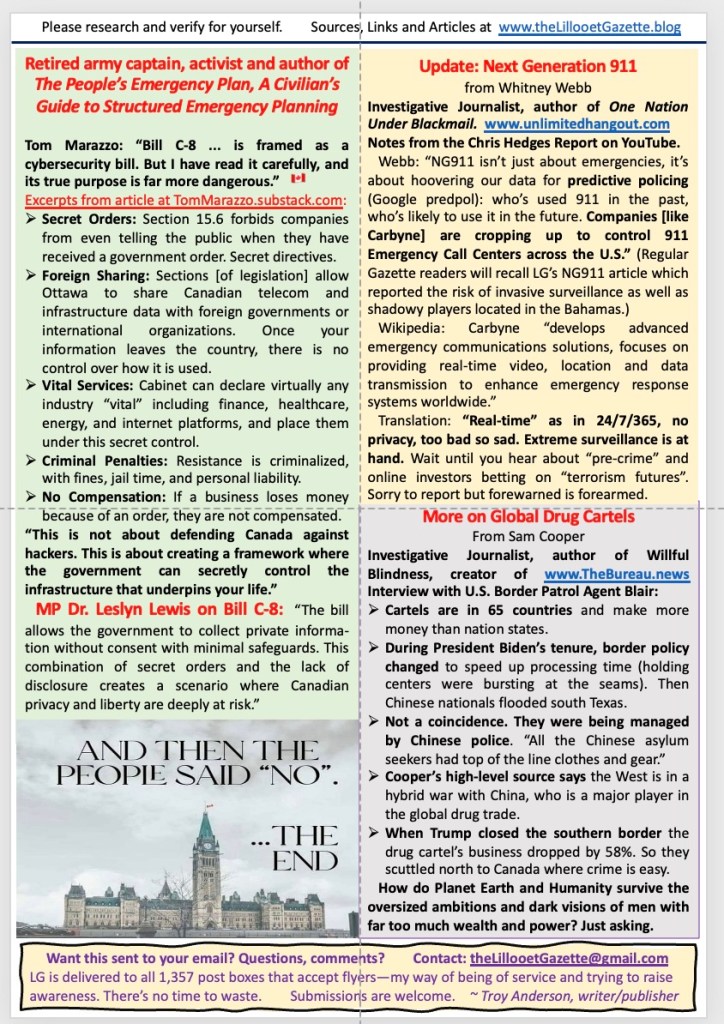
A screenshot of one issue.

Screenshot

How much difference it makes is debatable. The reality is, many people (too many) are chained to mainstream “news” and are oblivious to what’s happening. They just want to believe that those in power are good and carry on living their lives. I don’t blame them; acquiring knowledge takes its toll, there’s a sacrifice involved. I know because I’m living it. Six years ago I sat in front of the TV news and believed every word they said. Then, one auspicious day, it was like I had a bag ripped off my head and I realized I had to stop trusting. Gradually, with lots of research, I learned that they were betraying us, either unwittingly or by design. And by “they” I mean, the so-called elites and all the institutions they own and control, including the dinosaur media. The extent of lies and corruption is breathtaking and stinks something fierce. Learning how the world really works is hard on the soul. And very destabilizing.

Screenshot

But knowledge gradually brings inner growth and strength. It’s crucial to be able to see clearly and not be numb and dumbed down. They’re adept at keeping us brainwashed, confused, exhausted and obedient. The only way out—and a great way to regain your mental health—is to yank our attention away from mainstream media. We have the internet, it’s still easy to find high quality sources of information from the people with integrity who have our backs. Many of them are highlighted here in this blog. 

I’ll continue working and posting articles and I’ll continue to carefully watch what’s going on in Council and what the town’s administration is doing. As we all know, sunlight is the best disinfectant; without public oversight or media spotlight the people who manage things can lose perspective. The demise of the historic Bridge River Lillooet News (83 years!) started by the infamous, irascible, truth-loving Margaret (Ma) Murray came as quite a shock. And it’s a dangerous time to be without a newspaper.

For those of us trying to raise awareness and doing the hard work on behalf of everyone else, it’s best to remember the wise words of anthropologist, Margaret Mead: Never doubt that a small group of committed and thoughtful citizens can change the world; indeed, it’s the only thing that ever has. 


*Demise of historic Bridge River Lillooet News?

Quick, important note from the Feb. 3, 2026 Council Meeting

Joni L’Heureux, Chief Financial Officer (she’s back, FYI): “Community charter outlines the District’s requirement for advertising, public notices, rezonings, elections notices, things like that have to be published in the local newspaper two consecutive weeks. Recently, the availability and reliability of the Bridge River Lillooet News has been questionable. So being proactive about this, particularly because we have an election year coming up that will require a lot of public notices. We’ve drafted an alternative public bylaw [#2026-035].”

Alternative means of publications being put forward: REC center notice board and Facebook. Council briefly discussed bringing in a municipal app but the CFO said the cost of doing so would be prohibitive. Another place to post community information ought to be the Post Office. This blog will try to help by posting important information here. There will be more discussion at the next council meeting on Feb. 17th.

Here’s the notification that was inserted into the Jan. 15th, 2026 newspaper.

Notice to Readers and Advertisers

Regretfully, it will be necessary to pause publication of the Bridge River Lillooet News for several weeks while a series of technical issues is attended to. A malware or other hacking incident late last year has triggered cascading system failures and it’s simply no longer possible to find work-arounds while subsequently trying to fix these problems and continue to publish a newspaper every week. 

I don’t take this decision lightly; it’s a tremendous privilege and also responsibility to publish the Bridge River Lillooet News every week. That said, it’s irresponsible, at this point, to try to continue until the situation is properly in hand. It’s simply impossible to provide reliable service to readers and advertisers under these circumstances. 

I apologize for the inconvenience this will cause, and look forward to returning to regular publication as soon as it’s possible to do so. All subscriptions will of course be extended for all missed deliveries, and then some. 

Thanks for your patience and understanding. 

Dennis Stranack, Publisher

Bridge River Lillooet News

January 15,2026

* KICLEI UPDATE

Regular readers will recall the Gazette report that CAO McCulloch agreed to have a conversation with KICLEI’s Maggie Hope Braun. It was hoped she would inform him about sneaky globalist plans: climate action disguises systematic dismantling of democratic governance to weaken municipalities. Unfortunately, as soon as KICLEI was making some headway, it was attacked by the McMedia, in particular the National Post, which maligned and smeared using falsehoods, a common silencing tactic these days. Braun refuted the falsehoods but the stress took its toll. Long story short, for now, no conversation with the CAO. 

Braun reported: “At the FCM [Federation of Canadian Municipalities] conference, an ICLEI session labelled our message as “misinformation”. When councillors asked for a response to our documented concerns, ICLEI refused—saying even acknowledging our questions would “give them attention.” Let that sink in. “Elected officials are being told not to examine questions of jurisdiction, consent, or cost—because the answers might empower their communities. But it’s not working. Across the country, councillors are stepping up. 

“In Alberta, our issues became election issues. We are breaking through. And they know it. Wheatland County the Town of Vermilion and others withdrew from FCM, setting a precedent for others to follow. Lethbridge challenged PCP/IPCC targets, recommending a 20% GHG reduction instead of 40%–saving $63 million in projected carbon credit costs. In B.C., we exposed the truth: the Net-Zero Action Charter frameworks are voluntary, not mandatoryThat opens the door for respectful withdrawals and local debate. 

Reflecting on 2025 challenges, Braun said, “If you’re feeling burnt out or behind—so am I. But none of us are alone. Every email, delegation, and conversation you had this year helped lay a foundation for something powerful.” 

kiclei.substack.com

* Update: Next Generation 911 

from Whitney Webb, Investigative Journalist, author of One Nation Under Blackmail.  www.unlimitedhangout.com

Regular Gazette readers will recall LG’s NG911 recent article which reported on Lillooet’s CAO pursuing this new technology and the “free money” being given to those who adopt it. My research revealed the high risk of loss of privacy and rights, invasive surveillance, the militaristic language being used, as well as shadowy players located in the Bahamas. This update broadens that article with information gleaned from Chris Hedges’ interview of Whitney Webb on the Chris Hedges Report on YouTube—a pointed and important discussion about more of the nefarious motives for the so-called “upgrade” to 911 services.

Webb: “NG911 isn’t just about emergencies, it’s about hoovering our data for predictive policing (“predpol”): who’s used 911 in the past, who’s likely to use it in the future. Companies are cropping up to control 911 Emergency Call Centers across the U.S,” Webb said. 

One such company is Carbyne. From Wikipedia: Carbyne “develops advanced emergency communications solutions, focuses on providing real-time video, location and data transmission to enhance emergency response systems worldwide.” This is the translation: “Real-time” means your cell phone is connected to the grid 24/7/365, no privacy, too bad so sad. “Worldwide” means the centralization of all human data and the advancement of one world government and top-down controls by anonymous sociopaths who don’t live here. Extreme surveillance is at hand, people. But, as my research revealed, the current 9-1-1 will still be available, at least for the time being, so when they come knocking, selling you on how great this new NG911 is, scaring you with potential emergencies, touting the incredible benefits for your “safety and well-being”, shucking and jiving about ‘new and improved’, just say NO. 

Other folks have been keeping an eye on this issue, including Philip Perras, the mayor of Pender Island. He’s been sending lengthy letters to all municipalities in BC, including ours. The following is an excerpt from his December 2025 letter:

Systemic Accountability Failures and the E-Comm 911 Review

Two reports were released:

“These issues are not isolated. The independent EY review of E-Comm 911 completed in September (released publicly on November 7) — confirms what municipalities have been saying for years: the system lacked clear governance, financial controls, and meaningful oversight. EY found that accountability effectively stopped nowhere, with unclear authority, unpredictable levy increases and no contingency fund for emergencies — the very business they are in.

“The first identified major operational and budgeting failures and issued 25 recommendations, including stronger financial controls, a stakeholder-management framework, and a review of E-Comm’s 23-member board, which currently includes no Vancouver Island representation — despite Island municipalities being required to absorb downloaded levies. The second report outlined four possible service-delivery models and emphasized that the province’s role in emergency communications must finally be defined.

Importantly, while the Province had promised an independent review back in December 2024, it was the unity of the ten South Island mayors — standing together on the Legislature steps in January 2025 to protest the downloading of 911 costs — that forced the issue into the political foreground and ensured the review could not be quietly sidelined. Their public stance made it impossible for the Province to downplay, delay, or dilute the process, especially after years of unresolved concerns despite municipalities having been notified of the impending cost shift as early as 2019. For years, E-Comm operated on trust rather than transparency. The EY findings now confirm what local governments had been warning all along: accountability was missing, oversight was weak, and only municipal unity made the truth impossible to ignore.”


* CORRECTION NOTICE

The Lillooet Gazette in paper newsletter form, which is delivered to all 1,357 post office boxes that accept flyers (Canada Post will not allow the newsletter a “community news” designation so it has to be called a flyer), tries hard to get it right. But an error was made in the August/September issue. 

In the article Is Lillooet Falling Prey to Climate Piracy? it was stated that CAO McCulloch “appointed himself Corporate Officer on July 15th”. This was incorrect. McCulloch informed LG that he took on the Corporate Officer role by formal appointment of Council, not by self-appointment, in accordance with BC legislation. 

The Lillooet Gazette apologizes for the error.

But this cloud has a silver lining:

After a 30-minute discussion with the Gazette, CAO McCulloch agreed to have a conversation with KICLEI’s national director, Maggie Hope Braun. Stay tuned for that report! 

KICLEI (Kicking the International Council Out of Local Environmental Initiatives) reports: “In what may mark the quiet end of an era in international climate finance, the UN-backed Net-Zero Banking Alliance (NZBA) officially voted on October 3, 2025, to cease operations and dissolve its membership-based structure.” Canada’s six big banks are also out, as are all major American banks.

These are strong signals that Net Zero is a fantasy. And it raises important considerations for Lillooet. KICLEI: “Communities that focus on adaptation, self-sufficiency (which is in our Official Community Plan), and local decision-making are more resilent in the face of change. Whether preparing for floods, wildfires, or shifting markets, localism ensures solutions are flexible, cost effective, and tailored to real needs.”        See more at www.kiclei.ca

We don’t need to be controlled by greedy, unelected globalists who are accountable to no one. 


* MAYOR & COUNCILORS ON THE BALL

Councilor McNary rejected a bylaw requiring small businesses to provide EV outlet parking. “So, they’d be forced to become a gas station?” he asked. “They would have to pay for the electricity?”           Alpine Engineering in Kelowna, a consulting firm whose services cost taxpayers alot, are currently overhauling our “outdated” bylaws. Alpine also suggested a bylaw requiring homeowners to retrofit and install a 240-volt outlet, which Mayor Hopfl took umbrage with. Councillor Wiebe said new residential builders should not be mandated to include EV outlets. Councilor McNary informed council that “the BC Government is backing off EVs, our hydro grid cannot cope with EV charging.” 

Watch the lively discussions on YouTube, District of Lillooet, Sept. 16th at 49:00 minutes and Oct. 7th at 1:15 minutes. Public discussion and 3rd reading will be held on Nov. 4th   

SOME FACTS: 

(1) EVs are NOT GREEN.

(2) A mine takes 16 years to get up and running—Net Zero requires hundreds of thousands of mines and they destroy ecosystems.

(3) We don’t have electrical grid capacity.

(4) EV battery lasts about 170K kms, unless it bursts into flames or freezes in the winter. The cost to replace is $50K.

(5) People aren’t buying them.


* CANADA CANNOT STOP THE DRUG CARTELS??

The drug crisis is everywhere; it’s so severe St’at’imc Chiefs recently called local states of emergency. The cause of this tragedy is the federal government’s failure to prevent international drug cartels from taking hold, reports indie journalist and drug crimes expert, Sam Cooper.

“Two Supreme Court rulings—Stinchcomb and Jordan—have gutted the capacity to prosecute complex crime,” Cooper says. Stinchcomb Law requires all incriminating evidence be turned over to the defense before trial. This gives criminals a heads up, allowing them to change the parts that have been exposed. Jordan Law helps lawyers shield their clients; after being charged with an offence, defendants must be tried within a reasonable time frame (18 months, sometimes 30) but transnational crime networks are “incredibly complex and legal cases can’t be rushed”. Canadian law enforcement is hobbled. 

“Trump hates drugs,” Cooper states. When he closed America’s southern border, international drug syndicates quickly shifted to Canada. Cooper has documented that western Canada is now the epicenter of the global drug trade! Super labs are operating in Langley and Surrey and many other locations. Vancouver has become the world’s biggest exporter of meth. East Indian crime networks have taken over the long haul trucking industry, which facilitates the drug supply chain. Dirty drug money is laundered by real estate. “It’s been known for a long time,” Cooper says.  

Cooper: Trump’s tariffs are an iteration of America’s hammer coming down on Canada for this country’s complete failure to go after drug production. Americans are completely fed up with the dysfunction, trickery and lies from Ottawa. It’s not about who’s currently in Washington,” Cooper says, “it’s about this dangerous moment in history and whether or not Canada is going to survive it. Canadians would be shocked and fearful if they knew that we cannot stop these networks.”

Why don’t the media report any of this? CBC’s senior administration are tethered to Ottawa, which pays the CBC so it can exert editorial controls. Corporations owned by the 1% own all TV stations. CBCs “your world this hour” mantra is laughable. The “news” is 100% distraction tactics. 

What to do? Urge MP Caputo to get on this. Frank.caputo@parl.gc.ca or 250-851-4991

(Full story and more at TheBureau.news  OpEd: The Strong Borders Act Missed the Mark)

Who is Sam Cooper?

Author of Willful Blindness: How a Network of Narcos, Tycoons and CCP Agents Infiltrated the West

Reporter for two decades at the Province and Sun newspapers and Global TV. He left Global and created TheBureau.News which produces quality journalism and tells the truth. He’s highly respected and now advises international crime experts and members of the U.S. government. If that offends anyone, his eyes well up with tears when he talks about his love for Canada; like so many frustrated Canadians, he wants the political failures, incompetence and corruption to stop.    

This article quoted heavily from Cooper’s recent interview with Jason James on Brave New Normal podcast.

Here’s more discussion about the drug cartels, this time using a big, big macro lens, from the articulate, feisty, intelligent Elizabeth Nickson.


* CLIMATE PIRACY IN LILLOOET?

We better take an active interest in globalist policy because globalists are taking a very active interest in us – and council has accepted their money.

Climate bureaucracy gives “grants” that include control levers for worming their way inside the legal charters of communities like ours. Democracy and transparency end up being sidelines—without the awareness of CAOs, CFOs, Mayors and Councillors and definitely without taxpayers’ knowledge.

In 2023, Lillooet received an LGCAP (Local Government Climate Action Program) grant of $52,078 which has to be used for an approved climate category like CO2, GHG (greenhouse gas emissions), EVs, Net Zero. The former Chief Financial Officer held back the money but this year it’s been applied to an HVAC upgrade at City Hall. The upgrade reduces a tiny fraction of Canada’s tiny fraction of greenhouse gas emissions.

That “free money” required us to fill out and return a 19-page (!) climate action report comprised of detailed questions designed to micro-manage absolutely everything: new housing, roads, development, town assets, energy, transportation. Then CFO filled out the survey, avoiding much of the intrusive demand for information and action by stating that Lillooet did not have the financial capacity, or the expertise, to fulfill the request. Nevertheless, the report makes clear that the climate scam push is fully under way. “Free money” gives away our authority to make our own decisions and protect our fiscal solvency. Council must wake up to this long-term predatory scheme and opt out.

KICLEI (Kicking the International out  of Local Initiatives) helps town councils avoid these fiscal sinkholes: “What we’re seeing across Canada is a form of governance by proxy – where unelected global networks embed themselves into local government through programs like PCP (United Nations Partners for Climate Protection)m shaping policy through standardized plans and staff training. This isn’t violent—but it’s coordinated, ideological, and largely hidden from public scrutiny.”

“ICLEI and FCM (Federation of Canadian Municipalities) have created a system where one staff member and one councillor become the internal champions of a pre-scripted agenda. This mimics the structure of institutional capture—where outside influence steers local decisions through embedded advocates.” This is what it looks like:

“BE IT FURTHER RESOLVED that the municipality of Lillooet appoint…

  a) a corporate staff person and

  b) an elected official

to oversee implementation of the PCP milestones and be the points of contact for the PCP program within the municipality.

We’ve got two corporate staff persons — Deputy Corporate Office and CAO McCulloch who appointed himself (* see note below) Corporate Officer on July 15th. We taxpayers need to start paying attention; our apathy will allow the globalists to override democracy. Those who understand these threats and are quietly considering getting involved in local politics need to get elected asap!

*Post addition/correction: CAO McCulloch asked the Gazette to clarify that he did not “appoint himself” but rather he was appointed and he took an oath; it’s a legal requirement to have a Corporate Officer and the CFO leaving left that position empty. LG apologizes for the mistake.

If anybody would like to watch that in the council meeting, see it at the July 15th meeting at the 11 minute mark.