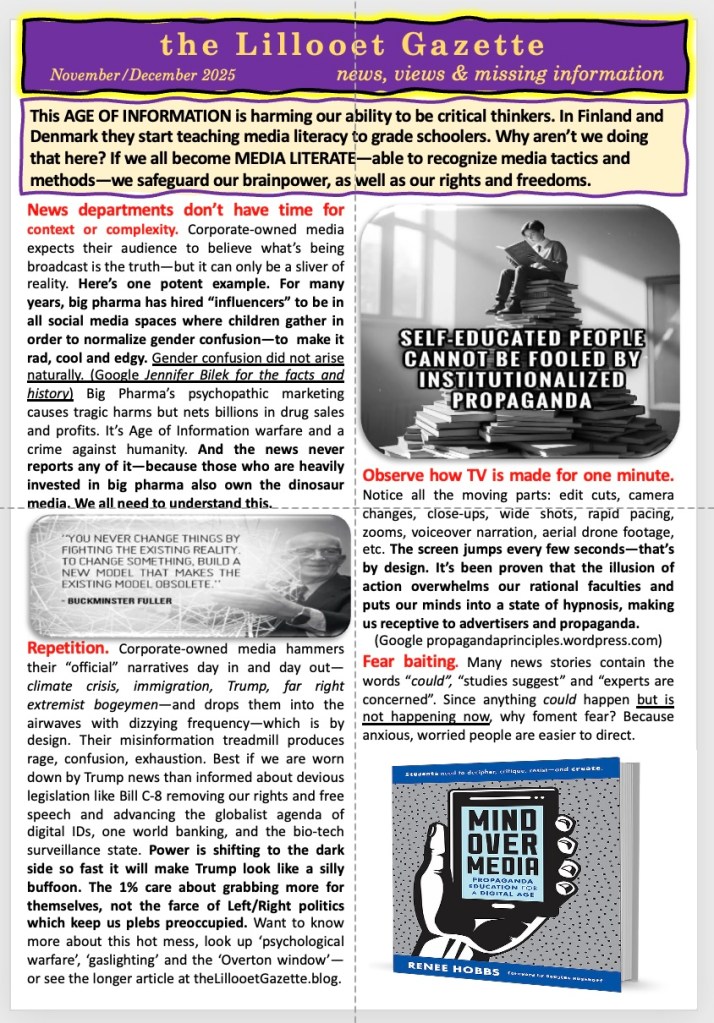
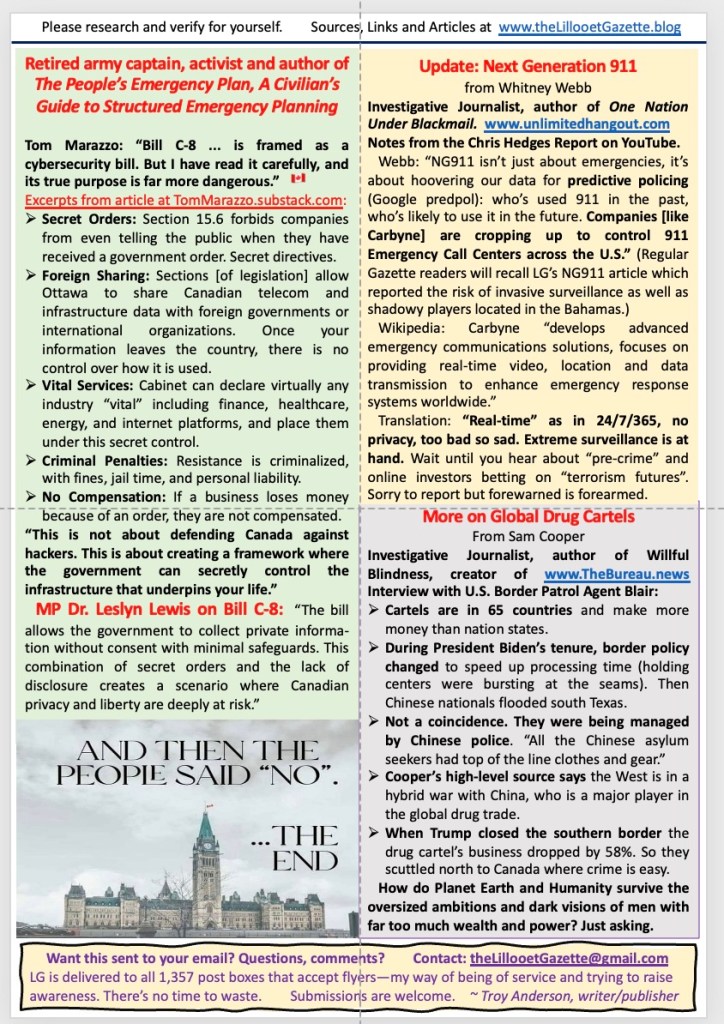
All things wacko in the state of Canada, by one of our very best investigative journalists ~ written with style and integrity. Of the many things you’ll learn reading this book is that many of the Chinese whales who came to Canada own, or owned, mines in China. Some of them sold the mines in order to turn swaths of Chinese land into real estate which was so expensive it was too difficult for the Chinese to buy. They caused tremendous harms, uprooted communities and rendered many people homeless and destitute. Some of those whales brought their lust for more real estate scams; some of them became ranking members of the Communist Party; some are deeply embedded in Triads and all things illegal, including fentanyl, which is decimating Canadian communities.
Wilful Blindness ~ How a Network of Narcos, Tycoons and CCP Agents Infiltrated the West by Sam Cooper
Teng Biao, Professor and human rights scholar, in his forward to the book: An open society must not be exploited by dictatorial regimes to monitor the diaspora communities and to spread its anti-democracy propaganda.
Regarding the detention and cruel treatment of Michael Spavor and Michael Kovrig by the CCP, “as an obvious retaliation for the detention of Meng Wanzhou. If Canadians have been shocked by the judicial blackmail, it is a wonderful opportunity to deepen their understanding of the characteristics of the regime..”
After the Tiananmen Square Massacre in 1989, with the help of Western engagement, money, and technology, the CCP has established increasingly powerful and brutal totalitarianism domestically and has become more and more aggressive on the international stage and a threat to global freedom. Its extraterritorial laws and long arm of enforcement overstretch in many different ways. For example, its control of Chinese immigrants, its economic coercion, and its abduction of refugees overseas, including dissidents, booksellers, Uyghurs, and businessmen. It’s theft, bribery, and propaganda are institutionalized through the Asia Infrastructure Investment Bank (AIIB), One Belt One Road (BRI), South China Sea aggression, international cyber attacks and espionage, manipulation of the UN human rights mechanisms, and the “Thousand Talents Program”.”
Calvin Chrustie: “It is a complex issue, but as stated yesterday [during a money laundering commission inquiry] while the flight of capital issue is a key concern, we know China’s financial elite have close ties to organized crime. And we also know the cartels are close to Chinese networks.”
Regarding underground banking, Cooper has extensively researched Silver International, located in Richmond, BC. “It was a stunning and terrible operation, laundering more than $1 billion each year in Vancouver for Chinese, Mexican and Iranian crime cartels. To my mind, Silver took on the shape of a financial weapon, a toxic creation that systemically eroded Canada’s economic foundations and the rule of law, while fulfilling the needs of transnational narcos and CCP oligarchs in elegantly balanced, symbiotic transactions—effortlessly shifting narco-dollars worldwide by leveraging massive reserves of corruption money seeking underground channels out of mainland China.
There is no dispute among criminologists about the cartel’s profound influence in Vancouver’s conversion into a hub for transnational crime. A 2015 report prepared by Canada’s anti-money laundering agency Fintrac says: “Vancouver is a critical money-laundering hub for: international drug money; dirty money from China (drugs, corruption, tax evasion). Transnational criminal organizations and local drug money.” The report says Vancouver is especially vulnerable to money-laundering because of its proximity to China and the U.S., its hot real estate market, and its busy marine port, which has been stripped of regulation by provincial and federal government funding cuts. (32)
“But if you focus on 1988, you have to zoon further back, all the way to China’s bloody Cultural Revolution and the year 1967, when overly aggressive members of Chairman Mao’s paratrooper Red Guards were purged and detained in Guangzhou.
“It was in these internment camps that the Red paratroopers formed a new Triad-like society, the Big Circle Gang, and the prisoners eventually escaped to Hong Kong, where they made a violent impression on the original Triads that had already fled to Hong Kong and Macau in the 1950s and 1960s, after losing bloody battles with Mao and the Communists. (50)
In Canadian federal court records regarding Triad infiltration of Canada’s immigration system, the Hong Kong police force’s leading Triad expert, Stanley Ip, is cited explaining the ancient roots of these secret societies. According to Ip, governments in China have, to various degrees, confronted the Triads since 1674—when leaders from China’s Han ethnic groups formed sects to buck the authority of the Manchurian Qing dynasty. The Triads functioned like shadow governments, evolving into powerful criminal societies controlling underground channels of finance and trade, and enforcing contracts through guanxi (relationships) and violence.
In the 1900s, secretive relations between national leaders and criminal leaders continued, Ip says, until Mao and the Communists firmly gained the upper hand and vanquished the Triads. But in the early 1980s, as negotiations progressed between the United Kingdom and China for the handover of Hong Kong, the pragmatic paramount leader Deng Xiaopeng had a new arrangement in mind. [China style capitalism] (50)
Sidewinder [1997 CSIS report] concluded that Canada faced a growing national security threat of economic infiltration driven by a network of allies from the Chinese Community Party. Triads and Hong Kong tycoons—all working together with Chinese intelligence services. And there was a shocking thesis: ahead of the conversion of Hong Kong from British rule, the CCP had forged a truce with the Triads in order to secure Hong Kong’s stability. [In 1982] Deng Xiaopeng “asked for cooperation and business advice from the Hong Kong tycoons. He wanted to smoothly adjust China’s economy to capitalism. In return, Beijing would give the tycoons privileged access to China’s markets. Two years later, Deng publicly stated that “not all Triads are bad, and many of the secret societies are patriotic.” (67)
Sidewinder said that throughout the 1980s, Western intelligence agencies recognized increasing activity in Hong Kong from one of China’s foreign intelligence arms, the United Front Work Department. United Front agents were responsible for fostering business ties between CCP and Triads. Bonds were forged with United Front shell companies that enabled Triads to run businesses in Mainland China with elite military and revolutionary families. (68)
“As early as 1992, Western intelligence services knew that Wong Man Fong, formerly head of the New China News Agency, was instructed to inform the Triad bosses that if they agreed not to jeopardize the transition process and the normal business in Hong Kong, Beijing would assure them that they will be allowed to pursue their illegal activities without interference,” Sidewinder said. For example, they set up a nightclub in Beijing with Deng’s Public Security Bureau chief Tao Siju, and also ran a number of similar clubs in Shanghai in partnership with People’s Liberation Army officers.
The allegations are shocking. But several media and academic reports have corroborated the secret deals between Beijing and Triad bosses.
And in his 2010 study “Beyond Social Capital,” Hong Kong criminologist T. Wing Lo reiterated Sidewinder’s findings on business ties between CCP and Hong Kong Triads. (68)
The Ye’s are one of the most powerful Red Army princeling clans, controlling vast military and industrial conglomerates. And they are known to be backers of Chinese leader Xi Jinping.
…Chinese criminals were taking over in western Canada. They had mastered drug importation and distribution. They had connections and routes worldwide. In B.C., they worked with the Vietnamese, the Persians, the Hells Angels and the new multi-cultural dial-a-doper gangs, the United Nations and Red Scorpions. Some of the bikers were still doing well. But they didn’t run Vancouver anymore. (78)
[Over the years, Chinese gangsters] got “better at moving narcotics around the world. Sending it out of Canada in stolen car exports, layering it into casino and hotel developments [Trumps?] in Vietnam and Cambodia, building towers in Mainland China, selling real estate across Asia, wiring funds back into Canada through import-export companies, mixing it into casino chips and homes in Vancouver and Richmond and Burnaby. (78)
[A police wiretap revealed that] It was no problem for the Chinese cartel to look into Canadian driving licence records. The Big Circle Boys were able to peer into Canadian residents’ lives and travel schedules and track them down if they wanted to. (82) It was something that citizens in the U.S. and Canada just couldn’t grasp. China’s government was directing the gangs. (82)
“And again, I have to hammer this point. Assessments from the Sidewinder report that were scorned in Ottawa power circles are supported by Canadian police wiretaps. China’s government is in fact controlling drug cartels.” (87)
Cooper tracks and explains “China’s so-called white gloves system and the Chinese Communist Party’s leveraging of criminal to gather intelligence.” (125) Lai [a Triad gangster] was allowed to monopolize China’s oil trade with his access to the country’s military vessels and ports. He robbed China’s economy and paid the dividends to himself and its leaders. But corruption of this scale can’t occur unless extremely powerful leaders pull the string. This is the white gloves system.” (125)
“In order to conceal their ownership of privatized state assets, Red Princelings use the ‘white gloves’ of People’s Liberation Army figures like Lai. In fact, after Lai fled to Canada, a young Fujian man named Ye Jianming who is believed to have Chinese intelligence connections, “bought” Lai’s oil assets at auction and built a transnational oil conglomerate worth about US$40 billion. That was before Ye was disappeared in March, 2018…
…”organized crime, espionage and corruption converge in China’s system”.
Dr. James Mulvenon, a Chinese military and espionage expert who has testified before a U.S. Senate Judiciary Committee: “There is widespread reports of rampant smuggling by the military of crude oil, petrochemical products, plastics, telecommunications equipment, guns, ammunition, chemical raw materials, steel, computers, cars, semiconductors, counterfeit money, drugs, cigarettes, electronics, and food.” (126)
[Some of their money found its way into U.S. politics] “The $300,000 was ultimately forwarded to Chinese agents and Macau casino bosses involved in fundraising for President Bill Clinton in the 1996 Clinton-Gore re-election effort.” (126)
In 2011 an elite cyberwar team operated from the PLA General Staff Department in Shanghai was monitored by U.S. investigators while mounting persistent attacks on corporate and national security assets in the United States and Canada. The team, called Unit 61398, is directed by the CCPs most elite leaders. It hacked into U.S. nuclear assets, United Nations computers, Canadian and U.S. government offices, and critical telecommunications infrastructure. (127)
Unit 61398 also hacked into Canadian Immigration and Refugee Board adjudicator’s computer. This was the adjudicator handling Lai’s case. The impact of the hack is unknown. Obviously, though, the hack was important for China. Unit 61398’s other famous target in Canada was Nortel, the world’s dominant Internet technology provider, until it collapsed in 2009 and China’s 5G champion Huawei rose in its place. (127)
In the 2004 Texas court case, Avramovic also alleged that casino staff were coached on how not to report loan sharking. Avramovic pointed directly to a former BC Gaming Policy Enforcement Branch (GPEB) employee who took a job with Great Canadian Gaming. “He’s been explaining how to avoid to report everything to the authorities.” His reward for blowing the whistle in 2004, according to Avramovic, was that the minister responsible for BC Lottery casinos, Solicitor-General Rich Coleman, harshly discredited him. (148)
BC’s Senator-General Rich Coleman oversaw both arms, the casino administrator and the regulator. He was a hulking man, about 6’4” and built like an NFL lineman. He was a former RCMP officer turned real estate developer turned politician. And people who have disagreed with him say he has little time for disagreements. (149)
It was insane when you turned it over in your mind. RCMPs special gambling enforcement unit was barred from entering government casinos. But big loan sharks were not. (150)
Pinnock believed he had accomplished something impossible in a supposed country of law like Canada. For having the temerity to suggest the RCMP should target organized crime in BC Lottery Corp. casinos, he’d become the whipping boy of BCs justice establishment.
There were at least seven major loan-sharking rings operating in Metro Vancouver casinos—about 50 known loan sharks—and they perpetrated horrific violence. (158)
Days later, a gambler walked into River Rock Casino with $460,000 in $20 bills and bought chips. The casino reported the large cash transaction, but stated “none of [the man’s] actions are suspicious.” (168)
“We’re suspicious that it’s dirty money,” Baxter said. “The casino industry, in general, was targeted during that time period for what may well be some sophisticated money-laundering activities by organized crime.” But Baxter’s highly public comments made BC’s solicitor-general Rich Coleman livid. “Yeah, I know what he said, and I don’t agree with him, and neither do all the superiors of his in the RCMP,” Coleman told the CBC. This was not true. Baxter’s superiors were aware of his comments, and they were approved. Baxter had seen videos of VIPs bringing stacks of cash into private casino cash cages. The GPEB investigators had trailed these VIPs from the casinos to nearby restaurants, luxury vehicles, and parking lots where they took delivery of bags of cash. (169)
The Chinese underground banking networks actually had taken over the so-called black market peso exchange from Columbian and Mexican money launderers. Jin and his gang were one piece of an incredibly complex shadow banking system that leveraged drug cash and international trade to launder Latin American cartel money from BC to China and back to Mexico and beyond. They were moving almost all of the cocaine, heroin, methamphetamine and fentanyl proceeds on the west coast of North America.
And as far-fetched as the premise of the joke—BC actually welcomes drug cash—GPEB and BCLC investigators had heard senior officials express similar thoughts. It was selective reasoning. The thinking was: crime and money-laundering will happen whether the government is running legal casinos or organized crime is running underground casinos. All societies have crime. You can’t stop people from gambling. So, the officials argued, the government should crack down on illegal casinos, and divert criminals into legal casinos, and vacuum up the dirty money, just like the tax. With the criminal proceeds reclaimed by government casinos, ‘profits’ could be used to pay for schools, hospitals and social programs. In other words, government casinos would become the ultimate money-laundering machine. In a banana republic narco state economy. It was insane. (177)
“The crime groups in Southeast Asia and the Far East operate with seamless efficiency,” Reuters quotes one police officer familiar with Sam Gor. “They function like a global corporation.” (196) And my network investigations showed his ‘global corporation’ could always be traced back to the gambling, real estate and construction businesses in Macau and Hong Kong and the casino gangsters in Vancouver and Toronto. (197)
Police were finding street labs producing illicit fentanyl, and it wasn’t just going to heroin addicts. Gangs were mixing it into drugs like ecstasy and methamphetamine. Unsuspecting teens were ingesting potentially deadly party pills. (206)
Kendall told me in 2012, there had been only 20 fentanyl deaths in BC. But in the first four months of 2013, there already 23 deaths. The fentanyl death rate started rising exponentially. And a BC public health emergency was declared in 2016. From 2016 through 2018 over 3600 people overdosed in BC, mostly in the Downtown Eastside. (207) how many today?
Adam Ross—author of a 2016 study for Transparency International Canada that showed about 50 percent of Vancouver’s luxury homes are owned through opaque legal structures—told me Canadian lawyers had failed at “self-policing.” (238) “The law societies claim to have rules in place to prevent money-laundering, but they are weak, non-transparent and almost never enforced,” Ross said. “Unless the law societies demand more of their members and start enforcing those rules, billions of dollars will continue to be washed through lawyers’ trust accounts without any consequences.” (239)
These were the business giants who owned mines and skyscrapers and ships and forests and highways in China. Men well-connected to China’s state and military and judicial elite. Men with access to ports in Qingdao, Harbin, Beijing, Shanghai, Guangzhou and Hong Kong. To put it another way, an intelligence source told me, a sort of power shift was playing out in Canada. The southern, Cantonese-speaking cartels may have had more autonomy in the early days of the Vancouver Model. But after 2008, the state-sponsored heavyweights of northern China appeared to gain influence over their networks in Vancouver and Toronto. (256)
Business relationships in Canada were formed in playgrounds of vice, Chinese community and RCMP intelligence sources explained to me. It was powerful guanxi. You want to come to my spa in Richmond and play with some girls? No problem. Want to play baccarat in government casinos—even better, lay bets in our own private VIP lounges and cash out winnings at Richmond currency exchange shops? How about a guided safari to kill some black bears? We have “special” relations with some Canadian officials, so don’t worry, it’s all taken care of. We can even ship polar bear mounts and hunting guns back to you in China. You’d like to develop some Vancouver real estate? Easy. Mingle with elite Canadian politicians in our China-Canada friendship association fundraisers? Done! (257)
According to my documents and a Mandarin speaker in Richmond who knew Paul Jin and saw him in action—Jin had found his true calling in life. A broker of vice for powerful men. [Sound familiar? Yet another Epstein] And a facilitator for their Chinese state activity in Canada. (257)
It was a simple equation. If betting limits for baccarat in Vancouver and Richmond could compete with Macau, BC government casinos would become attractive to the transnational whales. And so, limits were raised exponentially in British Columbia from the late 1990s to 2014. Baccarat bets starting at $25 per hand before 2000, despite many money-laundering warnings, peaked at a devastating $100,000 per hand in 2014. Of course, suspicious cash transactions rose exponentially too. (258)
In late 2017, two years after RCMP tactical units raided Silver [Silver International, the underground bank], in a Vancouver conference room Insp. Bruce Ward briefed a private audience. The crowd included U.S. Secret Service agents, financial professionals and Canadian police. This was information important to the Five Eyes intelligence allies, especially Australia, the U.S. and Canada. And I obtained a secret audio recording of Ward’s presentation. (259)
This is not an organized structure with comman and control,” Ward said, “It is more about business relationships. Because it operates very much parallel to the normal business community.” And as I learned about these networks, I honed my techniques for following the actors. Pictures can be a very important advertisement of guanxi between gangsters, politicians and professionals. And these network actors loved to post pictures of themselves raising glasses of red wine at galas attended by Chinese consulate officials and Canadian politicians. The political element would be something I delved into after understanding the narco element. (260)
“So this networking is what facilitated the business for Silver International,” Ward said. “Because they were able to start a profession of money-laundering for their friends in drug dealing, who needed the service of converting cash into bankable instruments.” But Silver first had to collect the cash. A number of businesses clustered into a few downtown Richmond blocks were seen by RCMP intelligence as the geographical supernode of drug-trafficking circuits in North America. (261)
And that is where the genius of Silver came into play. In Mainland China each citizen is barred from exporting more than $50,000 per year. There is incredible pent up supply in China’s banking system seeking to break that financial wall. And Paul King Jin, Silver International, and some Chinese industrialists had a solution, and a business model called Macau. (261)
The glittering city on the western shore of the Pearl River delta is called the Las Vegas of China for obvious reasons. Macau has been the hub of international transactions for centuries, a former colony of Portugal, transformed into an outlet valve for vices banned in China. It is a special administrative region for the Chinese Communist Party where casinos are legalized, the majority of GDP is derived from casinos, and the opulent gambling palaces have eclipsed Las Vegas in profitability, producing from $30 to $40 billion USD each year in revenue [much higher now, years after this book was published], at least three times more than the casinos in Nevada. This is where China’s 1 percent, elite state figures and Red princelings come to gamble and shop. (262)
In China, it is widely reported that corrupt officials have colluded with Hong Kong and Macau Triads to transfer state funds in and out of Macau through underground gambling junkets. And the scandals have reached all the way into China’s Politburo—the handful of CCP bosses who run the world’s second-largest economy—as illustrated by the cases of China’s former national security chief, Zhou Yongkang, and Bo Zilai, a north China governor so popular that he was considered a rival to Xi Jinping. Both leaders were linked in reports to Macau gangs and organized crime junket operators before each was convicted on corruption charges. In the case of Zhou Yongkang, who had control of China’s police and security forces, investigators linked his family to the flamboyant real estate and mining tycoon named Liu Han. (262)
Li Han had amassed a fortune of $6.4 billion and operated mines in Australia and the United States before he was tried and executed in 2015 on allegations that he had risen from “petty thug to billionaire”. His mistake had been his brashness and violence; with his fleet of luxury vehicles and mink coats, the facade of an industrialist was easy to see through. And before his death, the public learned he ran a cartel operating illegal casinos in China and laundering money through legal casinos in Macau, as well as trafficking weapons and providing contract-killing services. (263)
Zhou Yongkang, Liu Han and Bo Xilai were all taken down in sweeping corruption probes launched by China’s president, Xi Jinping.
In 2015, Macau’s GDP fell by 26 percent as fear of Xi’s corruption probes expanded. But even Xi’s family has been linked to the vices of corruption, offshore wealth, and foreign casinos. A joint investigation in 2019 by Australian media revealed that Xi’s cousin, an official named Ming Chai, was identified as a VIP gambler in Australian casinos, with links to prominent organized crime junket boss. And these junkets were connected to Chinese foreign influence and espionage networks. So this is the demographic of VIP gamblers that have helped build Macau’s wealth for decades by skimming funds from China’s underclass and making alliances with narcos and loan sharks and spies abroad. (263)
Me: A big RCMP raid of a Richmond underground casino failed; when they arrived at the $10 million mansion, it was abandoned and the date on a wall calendar was circled] (272)
Ward: “So this is a typical request. A direction from Silver International to move money from their own account to a drug dealer’s account. And we saw evidence of over 600 accounts in China that were controlled or fed by Silver International. So they would do that on your behalf. They would open up an account in China. You give them $100,000 cash in Richmond, and they wire transfer you $95,000 in China. [$5K is their fee]. In Vancouver, drug dealers with fentanyl precursor suppliers in Wuhan or Guangzhou could have Silver wire transfer funds to cartel accounts in China. These funds would result in more fentanyl arriving in Vancouver. Drugs would be sold, cash collected, funds wired to China, and the cycle repeated. And if the dealers had cocaine suppliers in Mexico or Peru, they could have Canadian banks wire transfer funds to drug dealer accounts in Latin America. (275)
July 2019. Canada’s Public Health Agency had put out brutal new statistics. Opioid overdoses had killed 10,300 Canadians from January 2016 to September 2018. There were almost 4,000 deaths in 2018 alone. Most of the fentanyl overdoses were in BC, Alberta and Ontario.
[Alderson] gave me the key to exposing the Vancouver Model. I took the 36 Jin VIP names and ran their I.D.s through BC land title and BC Supreme Court databases. I was looking for land ownership patterns, civil forfeiture cases, and disputes between investors. When flags came back connecting whale gamblers to various shell corporations, I could identify company directors and lending arrangements. I could tie in luxury auto leases, criminal record searches, associations with real estate lawyers, and the structure of land assembly and condo development deals. (296)
RCMP researchers cross-referenced these property documents with databases of criminal records and confidential police intelligence regarding ongoing investigations and networks of suspected criminals. And the results that came back were a blistering indictment of BCs economy. (302)
As the drug kingpins have raked in profits and the city’s real estate prices have surged, the fentanyl crisis has spread from its epicenter among addicts in Vancouver’s impoverished Downtown Eastside to communities across the country, leaving behind a devastating body count.” (308)
Since 2008 DEA had been running undercover agents into Hezbollah narco-launderers’ cells in Medellin, Dubai, Panama City. Agents discovered a web of businessmen just like Mehdizdeh collecting drug cash for Iranian state-sponsored criminals in cities worldwide.
In September 2019, when CSIS agents scoured the Ottawa condo of Cameron Ortis, a civilian RCMP intelligence official, they found dozens of encrypted computers. They also found evidence that Ortis was planning to leak Five Eyes operations plans to Altaf Khanani’s network (Iranian bros).
In basic terms, the United Front is “political warfare”, Manthorpe said. He said that Beijing had installed United Front agents in all Chinese consulates and embassies worldwide. These agents take orders from Beijing and control United Front Groups in cities worldwide. In Canada, United Front agents attempt to infiltrate all levels of government by influencing elected officials, sponsoring candidates for elections, and persuading business and academic elites to adopt the Chinese Communist Party’s foreign policy. Equally concerning, Manthorpe said, was the CCPs ideological usage of the United Front efforts to demand racial loyalty from all Chinese immigrants worldwide. (340)
…the United Front’s harassment in the Chinese diaspora aims to do. Silence dissent against the CCP and create a false image of unanimous support for Beijing’s policies. (350)
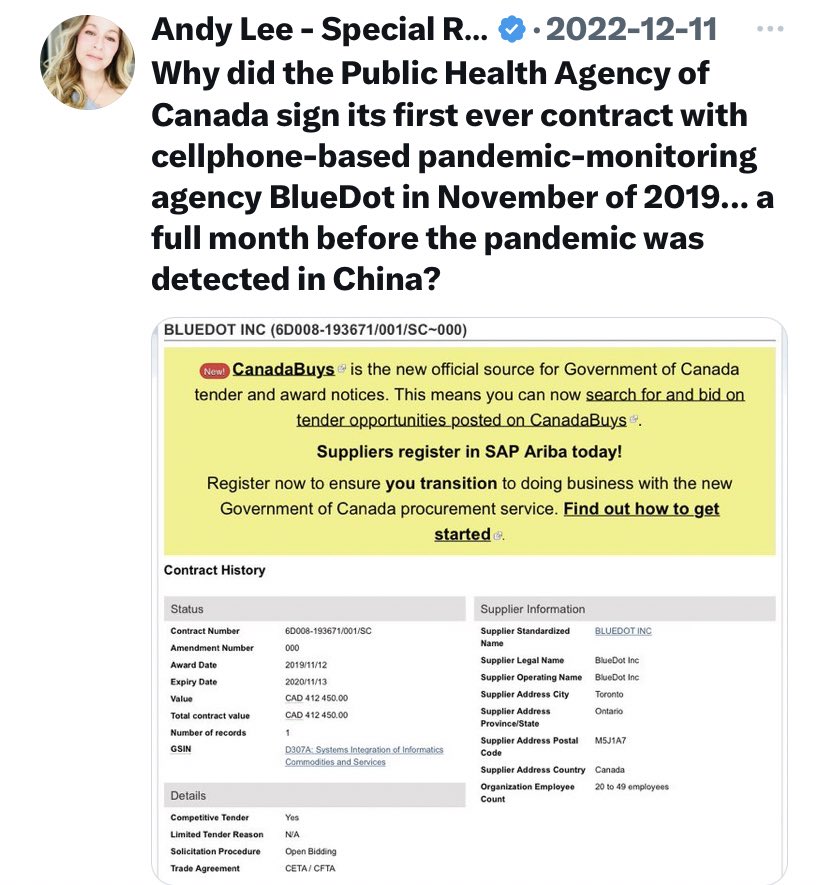
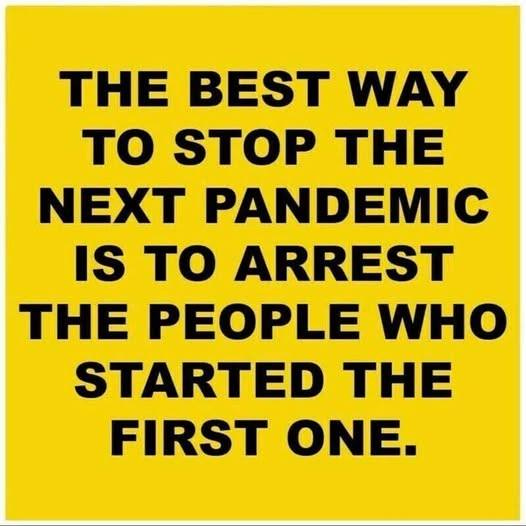
I have learned more about the outbreak in Wuhan. The evidence dovetails with an increasing number of statements from U.S. intelligence disease control officials, asserting that a disease matching the nature of the coronavirus was found to be spreading in Wuhan as early as October 2019. About 10,000 soldiers were at the World Military Games in Wuhan in October. And I learned from soldiers at the games that about one-quarter of Canada’s team became severely sick in late October, and they flew back to Canada under quarantine. These are extremely fit people. For such a large number of athletes to become sick at once is odd, to say the least. And there are open-source records and accounts from my military and intelligence sources indicating that Wuhan was significantly depopulated during the Military Games, and the Chinese state was engaged in strange behaviours. (359)
Empty highways, no construction workers, 1000s of empty high-rise apartments. All empty, the Canadian soldier wrote to me. Yes, there were a few people you would see, but this was a rarity. The explanation given by the staff at the World Military Games was that the CCP ordered everyone to leave the city to ‘make room for the athletes’. (359)
Underground banking and trade-based money-laundering run by transnational gangs connected to the Chinese state is the Canada Model, not the Vancouver Model. And opioid cartels from across Mainland China have merged into super cartels run out of Canada. These cartels have support from the Chinese Communist Party. They are key tools in Xi Jinping’s magic weapon. What I’m suggesting is that this information warrants a national inquiry in Ottawa. (382)
Sidewinder said that tycoons with connections to heroin Triads and the Chinese Communist Party and United Front were gaining a major foothold in Canadian real estate and hotels. And Ottawa’s response essentially was to shoot the messengers and ignore their warning. (383)
David Mulroney, Canada’s former ambassador to Beijing: “The Party is not squeamish about using any tool. If they catch someone doing something illegal, they will trade off a vicious sentence, perhaps a death sentence, in exchange for the criminal’s compliance. They hold this over the heads of people they are trying to co-opt. There is a very tight, incestuous relationship between organized crime in China and within diaspora communities, and the United Front. Co-opting criminal networks is one of the Party’s preferred tools for the infiltration of target organizations and communities and for foreign interference.” (384)
…China intends to not only profit from fentanyl production but to weaponize it, too. But what the sources are ultimately saying is the Chinese regime is purposefully using fentanyl against other states. And they are saying Canadians need to recognize the ruthlessness of Beijing’s compact with opioid cartels. Who are these sources? Some are RCMP criminal intelligence. Some are current and former CSIS agents. Some are from the DEA. Some are from the U.S. national security community. (385)
Australian federal police can get approvals to wiretap transnational narcos in several days. US police can “go up” on narco phone lines within a week. But after seven months in Canada, the RCMP could not get court approvals to tap the Sinaloa Cartel’s communications in Vancouver. This is why Vancouver has become one of the world’s most infiltrated narco, money-laundering and foreign intelligence hubs, and why Canada’s political and financial institutions are at grave risk of corruption. (387)
Powerful people decided the public should be kept in the dark. And so, in this book, I have tried to shine a light on this roiling pit of vipers. I have tried to show the public what police in Canada know, but can’t say. Canada lacks thee legal framework to cast a net over state-sponsored crime. Federal prosecutors need to start making big international cases like their counterparts in other Five Eyes countries. Australia is leading by example and facing harsh backlash from Beijing. Ottawa needs to start carrying its weight. But this will be very heavy lifting, sources say. Because Xi Jinping’s United Front has penetrated Canada deeply. (388)
“The tentacles of this thing. We are not talking about an emerging crime problem,” a source said. “This is 30 years of a crime trend that has entrenched itself into our upper levels of Canadian society. It’s frightening. The connectivity onto our business elites and corridors of power in Ottawa. It will take a long time to turn the tide.” (388)
-30-

 the Lillooet Gazette