Quick, important note from the Feb. 3, 2026 Council Meeting
Joni L’Heureux, Chief Financial Officer (she’s back, FYI): “Community charter outlines the District’s requirement for advertising, public notices, rezonings, elections notices, things like that have to be published in the local newspaper two consecutive weeks. Recently, the availability and reliability of the Bridge River Lillooet News has been questionable. So being proactive about this, particularly because we have an election year coming up that will require a lot of public notices. We’ve drafted an alternative public bylaw [#2026-035].”
Alternative means of publications being put forward: REC center notice board and Facebook. Council briefly discussed bringing in a municipal app but the CFO said the cost of doing so would be prohibitive. Another place to post community information ought to be the Post Office. This blog will try to help by posting important information here. There will be more discussion at the next council meeting on Feb. 17th.
Here’s the notification that was inserted into the Jan. 15th, 2026 newspaper.
Notice to Readers and Advertisers
Regretfully, it will be necessary to pause publication of the Bridge River Lillooet News for several weeks while a series of technical issues is attended to. A malware or other hacking incident late last year has triggered cascading system failures and it’s simply no longer possible to find work-arounds while subsequently trying to fix these problems and continue to publish a newspaper every week.
I don’t take this decision lightly; it’s a tremendous privilege and also responsibility to publish the Bridge River Lillooet News every week. That said, it’s irresponsible, at this point, to try to continue until the situation is properly in hand. It’s simply impossible to provide reliable service to readers and advertisers under these circumstances.
I apologize for the inconvenience this will cause, and look forward to returning to regular publication as soon as it’s possible to do so. All subscriptions will of course be extended for all missed deliveries, and then some.
The Lillooet Gazette in paper newsletter form, which is delivered to all 1,357 post office boxes that accept flyers (Canada Post will not allow the newsletter a “community news” designation so it has to be called a flyer), tries hard to get it right. But an error was made in the August/September issue.
In the article Is Lillooet Falling Prey to Climate Piracy? it was stated that CAO McCulloch “appointed himself Corporate Officer on July 15th”. This was incorrect. McCulloch informed LG that he took on the Corporate Officer role by formal appointment of Council, not by self-appointment, in accordance with BC legislation.
The Lillooet Gazette apologizes for the error.
But this cloud has a silver lining:
After a 30-minute discussion with the Gazette, CAO McCulloch agreed to have a conversation with KICLEI’s national director, Maggie Hope Braun. Stay tuned for that report!
KICLEI (Kicking the International Council Out of Local Environmental Initiatives) reports: “In what may mark the quiet end of an era in international climate finance, the UN-backed Net-Zero Banking Alliance (NZBA) officially voted on October 3, 2025, to cease operations and dissolve its membership-based structure.” Canada’s six big banks are also out, as are all major American banks.
These are strong signals that Net Zero is a fantasy. And it raises important considerations for Lillooet. KICLEI: “Communities that focus on adaptation, self-sufficiency (which is in our Official Community Plan), and local decision-making are more resilent in the face of change. Whether preparing for floods, wildfires, or shifting markets, localism ensures solutions are flexible, cost effective, and tailored to real needs.” See more at www.kiclei.ca
We don’t need to be controlled by greedy, unelected globalists who are accountable to no one.
Councilor McNary rejected a bylaw requiring small businesses to provide EV outlet parking. “So, they’d be forced to become a gas station?” he asked. “They would have to pay for the electricity?” Alpine Engineering in Kelowna, a consulting firm whose services cost taxpayers alot, are currently overhauling our “outdated” bylaws. Alpine also suggested a bylaw requiring homeowners to retrofit and install a 240-volt outlet, which Mayor Hopfl took umbrage with. Councillor Wiebe said new residential builders should not be mandated to include EV outlets. Councilor McNary informed council that “the BC Government is backing off EVs, our hydro grid cannot cope with EV charging.”
Watch the lively discussions on YouTube, District of Lillooet, Sept. 16th at 49:00 minutes and Oct. 7th at 1:15 minutes. Public discussion and 3rd reading will be held on Nov. 4th.
SOME FACTS:
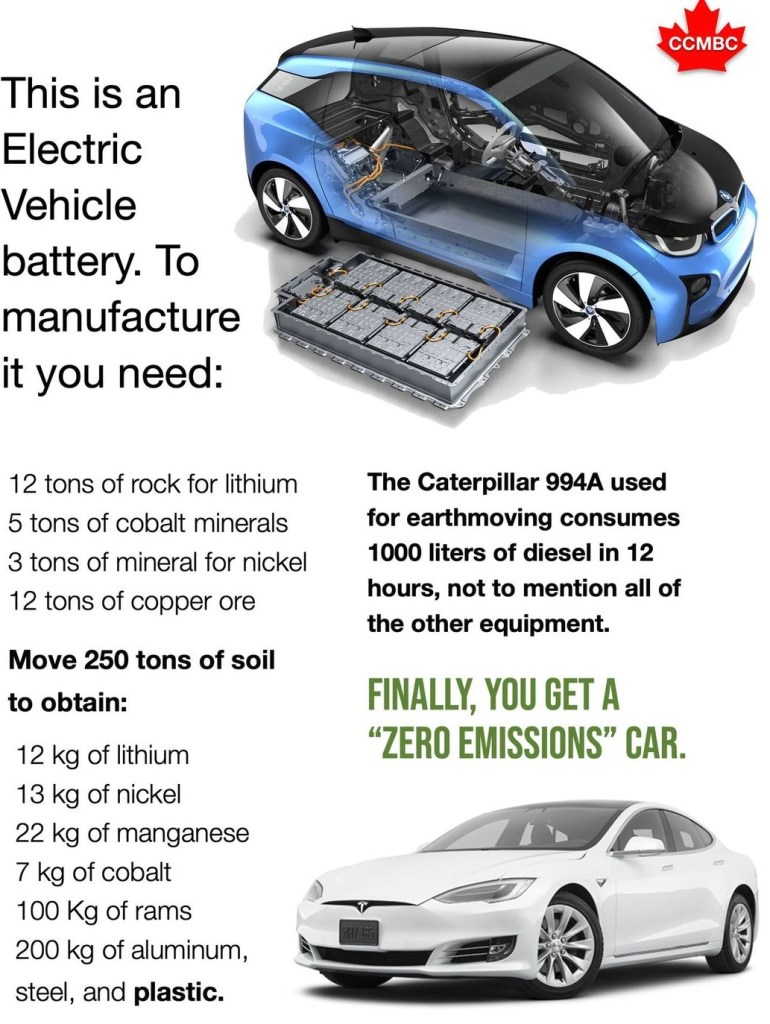
(1) EVs are NOT GREEN.
(2) A mine takes 16 years to get up and running—Net Zero requires hundreds of thousands of mines and they destroy ecosystems.
(3) We don’t have electrical grid capacity.
(4) EV battery lasts about 170K kms, unless it bursts into flames or freezes in the winter. The cost to replace is $50K.
Meet Maggie Hope Braun, the woman who’s transforming one local council at a time by exposing the global climate agenda infiltrating our Canadian towns and sucking millions of dollars out of fiscal budgets.
KICLEI stands for “Kicking the International Council Out of Environmental Initiatives”
Here’s a brief sample of what Kiclei offers, which they provide for free and by donation:
📌 Why are local governments quietly adopting global programs?
📌 What’s the hidden cost of “net-zero” at the municipal level?
📌 How can YOU get involved—and win?
Education. When councils are asked to spend millions on initiatives that reduce, say, 400 tonnes of CO2 annually, the public deserves context.
Here’s what 400 tonnes of CO₂ represents:
– 0.000069% of Canada’s annual emission
– 0.0000011% of global human emissions
– 0.000000019% of total CO₂ in Earth’s atmosphere
In other words: a drop in a vast atmospheric ocean.
Advocacy. We provide the tools, reports, and strategy to help you organize effectively and guide your municipality toward locally-driven solutions—without ICLEI, FCM pressure, or global policy frameworks. Lots of resources at kiclei.ca
Sign up for Kiclei’s excellent substack which is loaded with helpful information.
It’s now being introduced to our remote mountain town by the federal government.
Soon, there will be no more simply dialing three numbers on your keypad, NG911 is going to be next-level complicated. CAO Joe McCulloch appears to be gung ho. He reports in his published itinerary that on April 8th he updated the NG911 grant application. It was the only item on his itinerary for that day. Did he take the time to read the fine print? Let’s hope so.
When I researched and tried reading the fine print and it was an exhaustive labyrinth of complex jargon. Trying to find normal-speak information was impossible—because the documents aren’t supposed to be readily understandable?
Issues regular folk like me would be curious to know were absent—Who will pay for this? What are the company names? How will it work? What will be required of us to participate? How will my private information be protected? Who will see my private information?…etc.
NG911 has to bribe takers with up to $100K grant in order to get it. Since when do you get anything for free? So I emailed Joe, our accessible CAO who sees the public for two hours on the first Thursday of every month.
April 14, 2025
Hello Joe
Have you seen the contract yet for this plan to adopt NG911 in return for [grant] money upwards of $100K?
Anyone administering the town’s future commitments to something as sweeping as the NG911 needs to read the fine print of the contract and be prepared to explain it. There should be discussion and pubic consultation before any commitment.
On the surface, an upgraded 911 system appears to be a benefit that nobody could argue with, but the devil is in the details.
Data overreach is common these days and we would not want to find out that our privacy was given away when we should have been protected from privacy intrusion and data theft.
What is involved in “real time texting” for example? And very important, what exactly is meant by “other data transfers”?
Thank you,
Troy Anderson
NO REPLY. It being the only item on his itinerary for that day (page 120) perhaps that means he spent some time examining the concept documents instead of simply being a Yes man, we’ll take the free money, man.
Here’s what a couple of hours of my digging revealed.
NG911 purports to be the best thing since sliced bread for police, fire fighter groups and first responders. Can’t argue with that.
Scant benefits to the public are without discussion or elaboration: we, the millions, “could stream video from an emergency incident, send photos of accident damage or a fleeing suspect, or send personal medical information, which could greatly aid emergency responders.”
Ooh, spot the benefit, we’d be able to send personal medical information. That must have the fintech entrepreneurs salivating.
BUT, it appears that RTT may not be supported by the carriers who provide cell service to this remote location. Not much help to us then?
My initial research has me suspecting that NG911 is part of the ever-tightening noose that will restrict our freedom from pervasive, invasive surveillance. Every single person will have to have the app on their cell phone, which means our data, our contacts, our texts, and who knows what else, will be hoovered out on a regular basis.
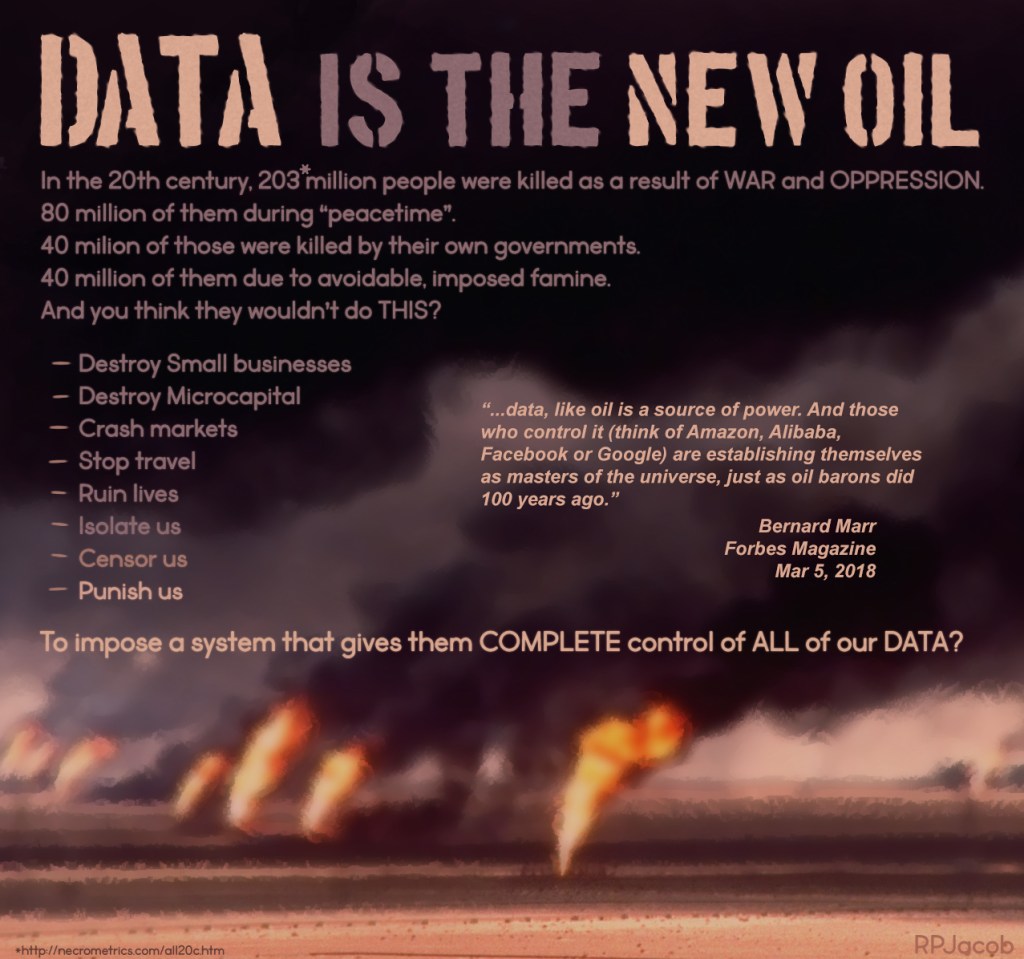
Does everyone know that data is being called the new oil? WE ARE THE DATA they want to exploit, monetize and scrutinize. Data is worth trillions, and it’s a huge topic.
If the repercussions of data harvesting aren’t disturbing, how about this? Getting in on the ground floor of NG911 is a group called the Coalition of the Willing (CW). Most of us have heard this phrase in connection with modern warfare. Among the Coalition of the Willing is the mysterious Windermere Group, located in the Bahamas, notorious home of offshore tax havens where the world’s greedy sociopaths hide their ill gotten gains. Why would they be part of the NG911?
From what I could find, the CRTC commission on NG911 identified “privacy issues” as a concern only once. And it was the last item under the heading of “List of Concerns” with zero discussion and zero mention anywhere else in the documents I read. Translation: our privacy is a very low priority, and/or they assume nobody is paying attention, and/or nobody will ever understand what they’re up to.
Which is probably just how they want it. “NG9-1-1 networks should be accessible to all types of entities, to the maximum extent possible, provided that they abide by the conditions established to govern access.” Govern access means the terrain is wide open for monetization, business opportunity, intrusive biometrics, constant surveillance, and who knows what else.
Last but not least about updating 911 technology: “These updates will not affect current access to 9-1-1. If you need emergency help, you will still be able to dial 9-1-1 as you do today.”
Municipal decision-makers must recognize the financial implications of “free” programs that later require substantial investment. Here’s how councillors can protect their communities from falling into these marketing traps:
Demand a Full Cost Breakdown Upfront: If a program is “free,” councillors should ask what long-term costs are involved and insist on seeing cost analyses before agreeing to participation. How much have these projects cost municipalities over the last 30 years?
Be Skeptical of Programs That Require Data Collection: If an initiative asks for extensive data before revealing costs, it is likely a long-term commitment disguised as a trial.
Consider the Exit Strategy Before Signing On: Councillors should assess how easy it will be to withdraw if the costs become unmanageable and develop an opt-out plan.
Prioritize Local Adaptation Over Global Mitigation: Instead of investing in top-down, international net zero frameworks, municipalities should focus on local climate adaptation strategies that bring direct benefits to their communities—such as flood prevention, infrastructure resilience, and regenerative agriculture.


 the Lillooet Gazette